Empower Your Business With The Magic Of Machine Learning!
- +30 210 9701777
- Aristotelous 83, Athens 163 43
- contact@mobiplus.co

Empower Your Business With The Magic Of Machine Learning!
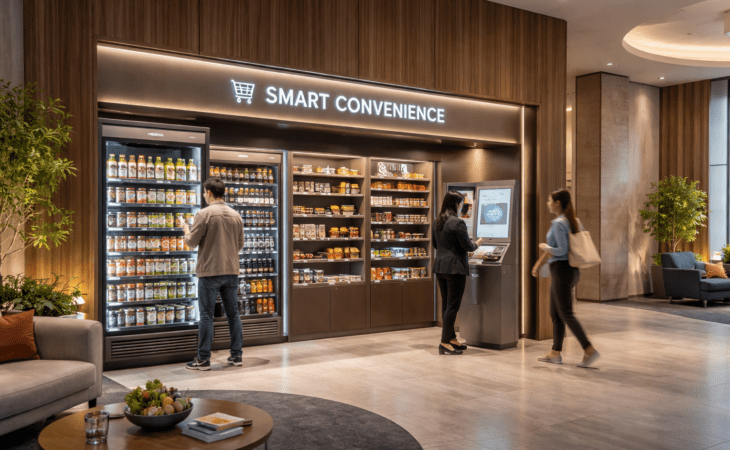
A Vision for the Future of Everyday Living
The expectations of residents and tenants have fundamentally changed. Over the past decade — accelerated by digital transformation, mobile-first lifestyles, and AI-driven commerce — convenience has become a baseline expectation rather than a premium feature. Residents now expect the same immediacy and seamless accessibility in their physical environments that they experience online.
Property developers, asset managers, and real estate investors are therefore facing a strategic inflection point: buildings are no longer evaluated solely by location, aesthetics, or structural quality. They are judged by the quality of experience they provide — and increasingly, by the intelligent services embedded into daily life within them.
This is where Smart Lobby Convenience Stores enter the picture.
A Smart Lobby Convenience Store is an unattended, technology-enabled retail amenity located inside residential or mixed-use building lobbies. It provides residents with instant access to everyday goods — snacks, beverages, household items, essentials — without requiring staff, dedicated retail space, or traditional leasing models.
Residents simply walk into the lobby, select products through intuitive automated retail systems, and complete purchases seamlessly via modern payment interfaces. No queues. No operating hours. No friction.
For developers, the result is not just another amenity — it is a strategic value amplifier that enhances market differentiation, tenant satisfaction, and long-term asset competitiveness.
This article explores the concept in depth: what it is, why it matters now, how it benefits developers, and why forward-thinking projects are adopting it as a standard feature.
From Static Infrastructure to Experience Platforms
Historically, amenities followed a predictable evolution:
Smart Lobby Convenience Stores belong squarely in this fourth phase.
They reflect the transformation of buildings from passive structures into active service platforms — environments that anticipate needs, reduce friction, and elevate daily life.
This shift aligns directly with:
Developers who embrace this transition position their assets at the forefront of next-generation living.
What It Is (and What It Isn’t)
A Smart Lobby Convenience Store is not:
Instead, it is:
Typical Capabilities
Residents benefit from effortless access. Developers benefit from strategic differentiation.

Market Forces Converging
Several macro trends are aligning to make this concept particularly relevant:
1. Changing Resident Expectations
Modern residents prioritize convenience above many traditional amenities. The ability to grab essentials within seconds is viewed as a lifestyle baseline.
2. Retail Space Economics
Ground-floor retail leasing is increasingly complex and risky. Smart retail alternatives:
3. Operational Efficiency Pressures
Developers and operators seek amenities that:
Smart unattended retail aligns perfectly.
4. Technology Maturity
Hardware, payment systems, IoT telemetry, and analytics platforms have reached reliability levels suitable for enterprise deployment.
This was not true five years ago. It is true now.
Strategic Benefits for Property Developers
1. Differentiation in Competitive Markets
Developments compete fiercely on amenities. Offering smart convenience access signals:
It strengthens marketing narratives and leasing positioning.
2. Increased Tenant Satisfaction and Retention
Convenience services contribute directly to perceived living quality. Residents value:
Higher satisfaction correlates with:
3. Enhanced Asset Value Perception
Smart infrastructure is increasingly viewed as part of premium building identity.
Automated retail contributes to:
4. Efficient Space Utilization
Unlike traditional retail units:
Developers convert small underutilized areas into service-generating amenities.
5. Potential Revenue Participation Models
Deployment structures may include:
Creating potential financial upside without operational complexity.
6. Data-Driven Insight Opportunities
Intelligent systems generate usage analytics:
These insights can inform broader amenity planning and service optimization.
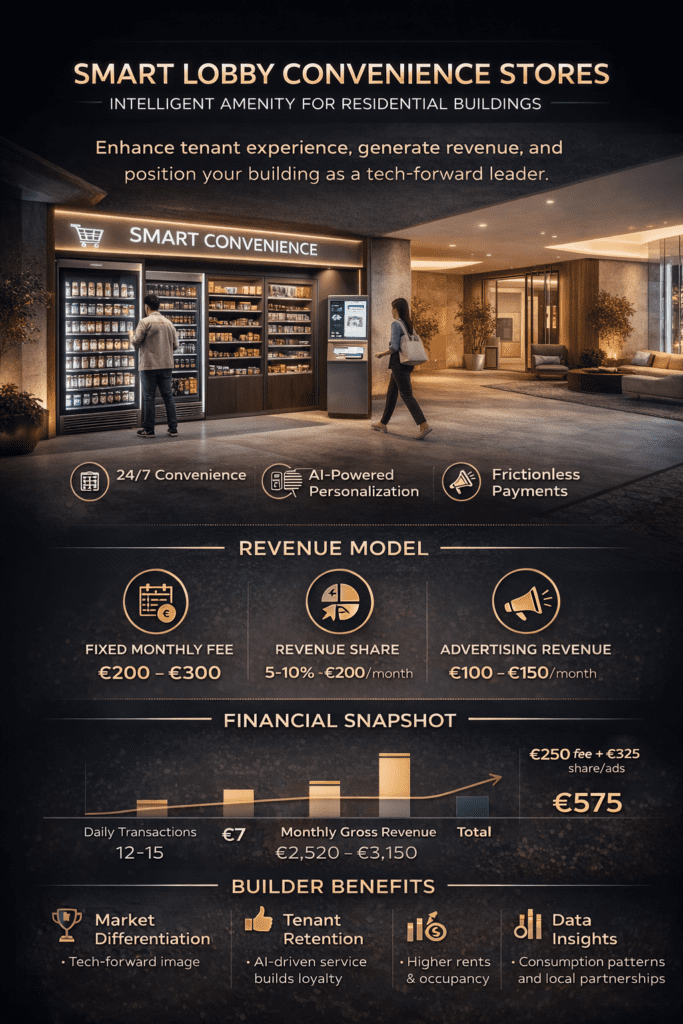
Convenience as a Daily Lifestyle Layer
Imagine a typical resident scenario:
Late evening return home.
Need beverages, snacks, or essentials.
No desire to drive, walk, or wait.
The lobby solution provides:
Over time, this builds habitual usage and strong emotional association with building convenience.
That emotional association matters.
It shapes satisfaction.
It shapes reviews.
It shapes referrals.
Deployment Simplicity
Minimal Disruption, Maximum Impact
Compared with other amenity installations:
This makes the concept highly adaptable across:
Positioning Within Smart Building Strategy
Smart Lobby Convenience Stores should not be viewed as isolated features.
They integrate into broader smart ecosystem layers:
They represent a natural extension of intelligent building environments.
Why the Technology Partner Matters
Hardware alone does not define success.
The real differentiator lies in:
This is where experienced technology partners provide transformative value.
Read our book and learn why instore personalization and shopping data is the name of the game.

A Legacy of Enterprise Technology Innovation
Our foundation is built on over four decades of experience in enterprise systems and technology integration across global ecosystems.
Our background includes experience spanning environments connected with:
These experiences have shaped our understanding of large-scale systems reliability, enterprise-grade integration, and operational resilience.
Retail Innovation Leadership
We have consistently worked at the intersection of retail and technology:
As active contributors within innovation communities such as:
We approach unattended retail not as equipment deployment — but as an integrated digital commerce layer within physical environments.
What We Bring to Developers
We manage:
Developers gain:
Early Adoption Creates Market Leadership
Amenities evolve in cycles.
Those who adopt early:
Those who follow:
Smart Lobby Convenience Stores are currently in early adoption phase across many regions — representing an opportunity to lead rather than follow.
Envisioning the Future
This concept is only the beginning.
Future evolutions include:
Deployments today establish the infrastructure for tomorrow’s intelligent living experiences.
Smart Lobby Convenience Stores represent a convergence of:
They provide a rare alignment of:
We believe the developments that incorporate intelligent service layers today will define the competitive landscape of tomorrow.
If you are exploring how to elevate the experience within your buildings — not incrementally, but meaningfully — we welcome a conversation.
Let’s explore how intelligent convenience can become a defining characteristic of your next project.

Test out the Recommendation Engine for up to 20.000 euros in revenue from recommendations. No credit card required. Just enter your company information and we’ll contact you with all the details.
