Empower Your Business With The Magic Of Machine Learning!
- +30 210 9701777
- Aristotelous 83, Athens 163 43
- contact@mobiplus.co

Empower Your Business With The Magic Of Machine Learning!
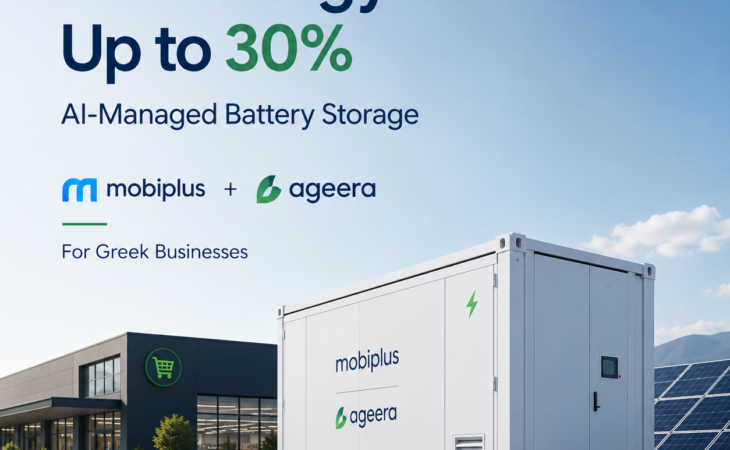
Greek commercial and industrial companies are entering a new energy era.
For many years, electricity was treated mainly as an operating cost. It was something that the CFO monitored, the facility manager managed, and the company tried to control through better contracts, lower consumption, or solar investments. But the energy market has changed.
Electricity prices are volatile. Grid capacity is becoming a real limitation for business growth.
Sustainability pressure is increasing. Critical operations need reliable power.
At the same time, companies are looking for new ways to reduce costs, improve margins and create new revenue streams.
This is why energy can no longer be treated as a passive cost.
For large commercial and industrial companies, energy infrastructure is becoming a strategic asset.
A factory, a supermarket chain, a logistics center, a cold-storage facility, a hotel group, a data center, a hospital, a shopping center or an industrial park does not only consume electricity. It has an energy profile.
It has peak demand. It may have solar production. It may have refrigeration, air conditioning, machines, compressors, EV chargers, UPS systems and generators. It may have flexible loads. It may have periods where electricity is expensive and periods where it is cheap.
It may have power-quality risks or grid limitations. All these create opportunities.
The question for CEOs and CFOs is no longer only:
“How do we pay less for electricity?”
The new question is:
“How do we turn our sites into intelligent energy assets that reduce costs, protect operations and create new revenue?”
This is the opportunity that Mobiplus and Ageera are bringing to Greece.
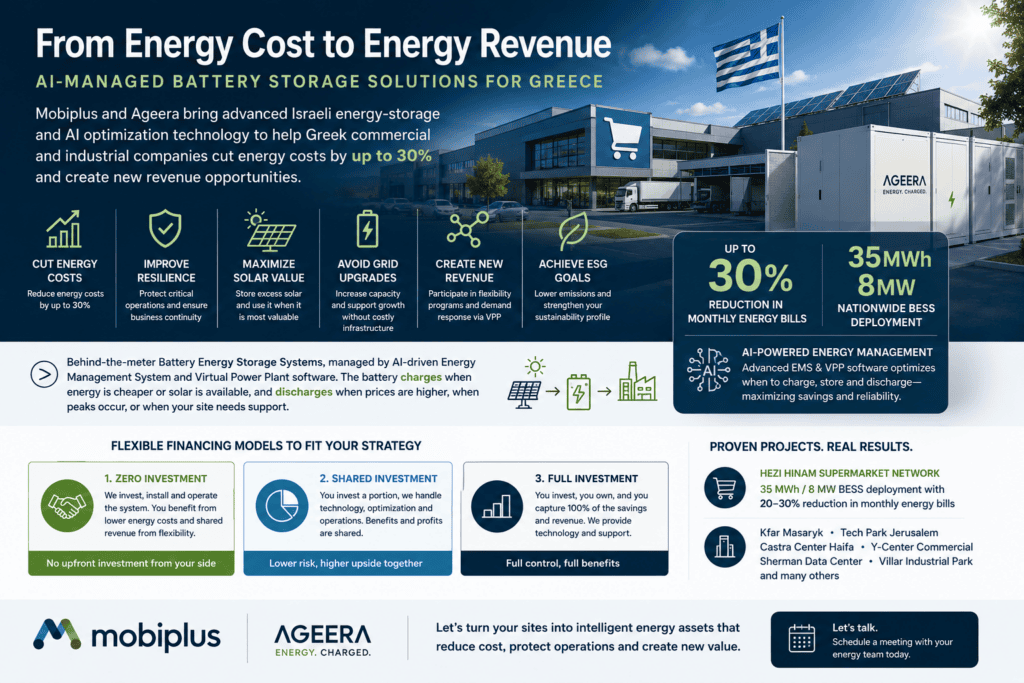
Mobiplus, together with Ageera, introduces an advanced Israeli energy-storage and AI optimization technology for Greek commercial and industrial companies. The solution combines behind-the-meter Battery Energy Storage Systems, advanced Energy Management System software, Virtual Power Plant optimization, AI forecasting and flexible financing models — including a zero-upfront-investment model for qualified customers.
The objective is clear: to help large energy consumers cut energy costs by up to 30%, improve energy resilience, support sustainability goals, reduce dependence on costly grid upgrades, and create future revenue opportunities from energy flexibility.
This is not simply a battery installation.
It is an AI-managed energy transformation.
Greek companies are facing several energy challenges at the same time.
The first is electricity cost volatility. Prices can change significantly depending on market conditions, time of day, weather, renewable generation, demand, geopolitical factors and grid constraints.
For companies with high energy consumption, this volatility affects margins directly. A supermarket with refrigeration, a factory with production lines, a hotel with air conditioning, or a logistics center with cold storage cannot simply stop consuming electricity when prices rise.
The second challenge is peak demand. Many companies do not consume energy in a smooth, stable way. They have peaks during hot summer days, production shifts, refrigeration cycles, machine start-ups, loading operations, hotel occupancy peaks, or EV charging periods.
These peaks can create high charges, stress the electrical infrastructure and force the company to contract for higher power capacity.
The third challenge is grid capacity. Many companies want to grow. They want to add production lines, expand facilities, install more refrigeration, electrify vehicle fleets, add EV chargers, install heat pumps, develop data-center capacity, or increase solar generation. But in many areas, the local grid cannot easily provide additional capacity, or the process is slow and expensive. A grid upgrade can take months or years. For a growing company, this becomes a business constraint.
The fourth challenge is renewable-energy integration. Many companies are installing or considering solar PV. But solar production does not always match consumption. A company may produce energy at noon but need more energy later in the day. Without storage, some value is lost. A battery allows the company to store solar energy and use it when it creates the highest benefit.
The fifth challenge is operational resilience. Critical operations cannot afford power interruptions or poor power quality. Food retail depends on refrigeration. Data centers depend on uptime. Factories depend on production continuity. Hotels depend on guest comfort. Logistics centers depend on uninterrupted cold-chain operations. Even short outages can create product losses, downtime, customer disruption and reputational risk.
The sixth challenge is ESG. Investors, boards, customers and employees increasingly expect companies to reduce emissions and use energy more intelligently. But ESG must be practical. It must be connected to real operational and financial benefits, not only reporting.
This is where AI-managed battery storage becomes relevant.
It can reduce cost. It can improve resilience. It can increase renewable-energy use. It can support growth. And, in the next phase of the market, it can create new revenue from flexibility and demand response.
The Mobiplus–Ageera solution is based on behind-the-meter Battery Energy Storage Systems.
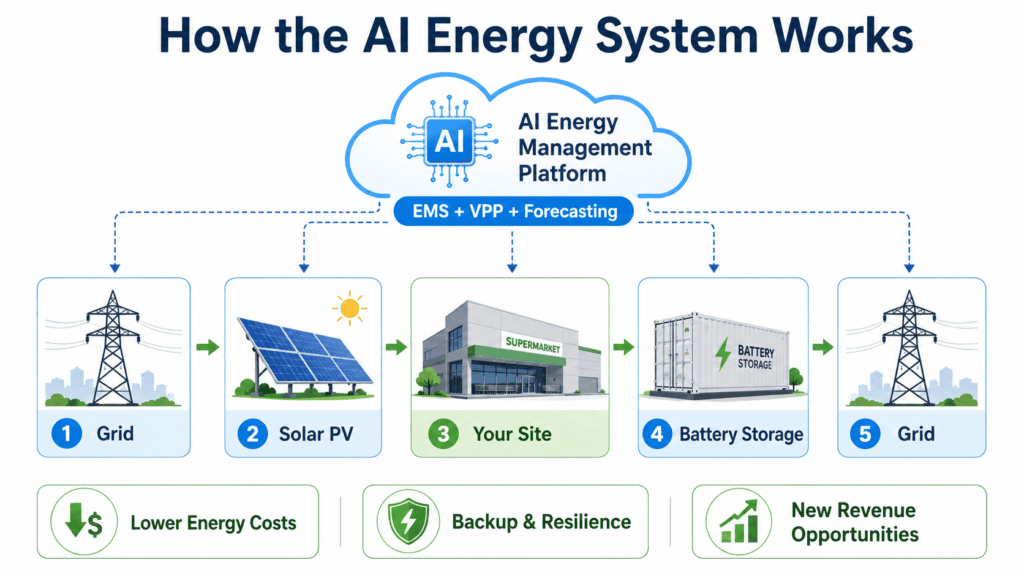
“Behind-the-meter” means that the battery is installed inside the customer’s own site, after the electricity meter, connected to the customer’s electrical infrastructure.
It works together with the grid, the site’s loads, solar PV, generators, UPS systems, EV chargers and other energy assets.
The battery charges when energy is cheaper or when solar production is available. It discharges when electricity prices are higher, when demand peaks occur, when the site needs support, or when the energy management software identifies an opportunity to reduce cost or create value.
The key point is that the battery is not operated manually.
It is managed by advanced software.
Ageera’s Energy Management System monitors the site in real time. It sees consumption, generation, battery state of charge, electricity prices, solar production, demand peaks, technical limits and operational conditions.
The system decides when to charge, when to discharge, how much energy to reserve, how to protect the battery, and how to maximize financial value.
On top of the site-level energy management, the Virtual Power Plant platform can aggregate many sites into one coordinated energy portfolio.
This means that a supermarket chain, a logistics network, an industrial group or a property portfolio can operate many distributed batteries as one intelligent energy asset.
This is the strategic change.
A company no longer sees each site only as a consumer of electricity. Each site can become part of a distributed energy platform.
The financial and operational value comes from several use cases.
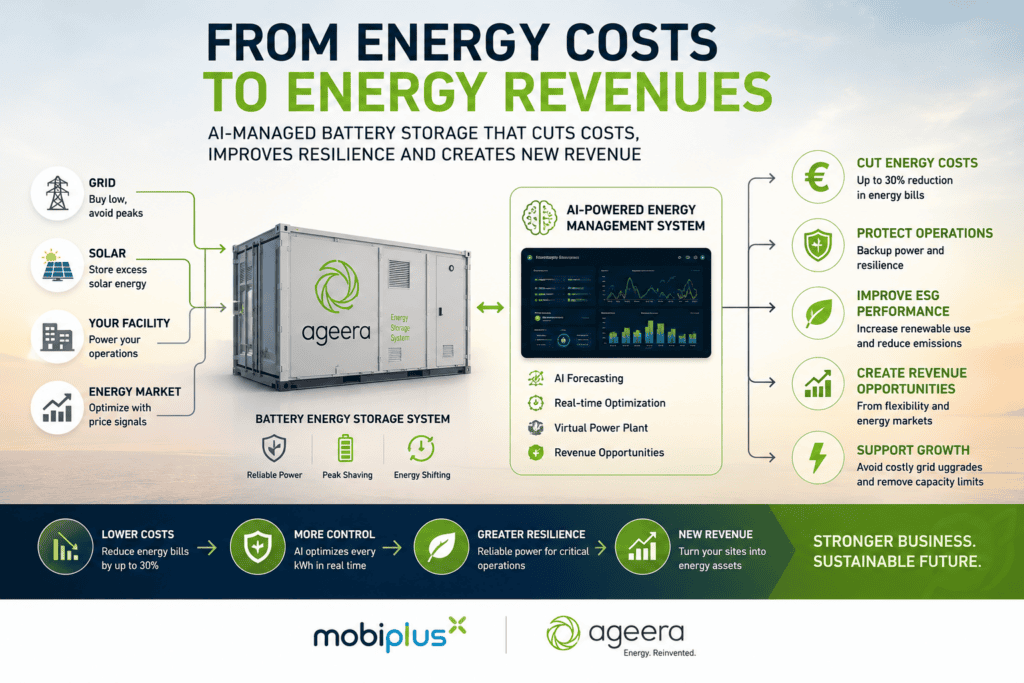
The first is peak shaving. If a factory, supermarket or hotel has short periods of very high demand, the battery can discharge during those moments and reduce the power drawn from the grid. This can reduce demand charges, lower stress on the electrical installation, and help the company avoid increasing its contracted power.
The second is load shifting. The battery can charge during low-cost periods and discharge during high-cost periods. Instead of buying expensive electricity at peak times, the company uses stored energy.
The third is energy arbitrage. When market prices vary during the day, the system can buy or store electricity when it is cheaper and use or sell value when it is more expensive. This requires advanced forecasting and optimization.
The fourth is solar self-consumption. If the company has solar PV, the battery stores excess solar energy and uses it later. This improves the return on solar investment and reduces grid consumption.
The fifth is backup and resilience. The battery can support critical loads during outages or power-quality events. In a supermarket, this can protect refrigeration, POS systems, lighting and communications. In a data center, it can support uptime. In a factory, it can protect critical production or control systems.
The sixth is grid-upgrade avoidance. If a site wants to expand but its grid connection is limited, the battery can provide extra power during peak moments. This can delay or reduce the need for expensive grid upgrades.
The seventh is flexibility revenue. When many batteries are connected through a Virtual Power Plant, the portfolio can participate in demand response or flexibility programs through an aggregator. The company can receive value not only from saving electricity, but also from supporting the electricity system.
The eighth is ESG value. By improving solar utilization, reducing peak stress and supporting renewable integration, the system helps the company demonstrate measurable sustainability action.
These benefits are not theoretical.
They are the reason why energy storage is becoming a strategic tool for large commercial and industrial energy consumers globally.
A battery without intelligence is just hardware.
The real value comes from deciding every day, every hour and sometimes every few seconds what the battery should do.
Should it charge now or wait?
Should it discharge now or reserve energy for later?
Should it support peak shaving or backup?
Should it prioritize solar self-consumption or market arbitrage?
Should it participate in a flexibility event or stay available for the site?
How do we create value without damaging the battery?
How do we forecast tomorrow’s load, prices and solar production?
These are optimization questions.
The Ageera platform uses AI-driven forecasting, energy management and Virtual Power Plant logic to make these decisions.
It analyzes the customer’s consumption behavior, solar production, market signals, weather, battery health, technical limits and operational priorities.
For a supermarket, the system may learn the refrigeration and air-conditioning patterns.
For a hotel, it may learn seasonality, occupancy and weather-driven demand.
For a factory, it may learn production shifts and machine peaks.
For a data center, it may learn critical uptime requirements.
For a logistics center, it may learn cold-chain and loading-cycle behavior.
This is why the same battery can create different value in different industries.
The technology must understand the site.
Greece is a strong market for this solution.
The country has high solar potential, increasing renewable penetration, grid-congestion challenges, volatile electricity prices, growing interest in energy independence, and many commercial and industrial customers with significant energy needs.
Good target sectors include supermarkets, food retail, cold storage, logistics, manufacturing, pharma, food production, industrial parks, large hotels, resorts, shopping centers, hospitals, ports, airports and data centers.
In supermarkets, the opportunity is strong because refrigeration and HVAC create continuous and peak demand. Stores also have potential roof or parking areas for solar PV, and the network structure creates a future VPP opportunity.
In cold storage and logistics, energy reliability is critical. A power event can affect stock, operations and service commitments.
In factories, batteries can reduce peaks, support production continuity and optimize energy use around production schedules.
In hotels and resorts, batteries can support summer demand peaks, improve solar economics and protect guest operations.
In data centers, the value of resilience and uptime is extremely high.
In industrial parks, multiple sites can potentially be aggregated into a local energy platform.
This means Greece is not only a market for individual batteries. It is a market for intelligent distributed energy infrastructure.
One of the most important elements of the Mobiplus–Ageera proposition is that the customer does not necessarily need to make a large capital investment.
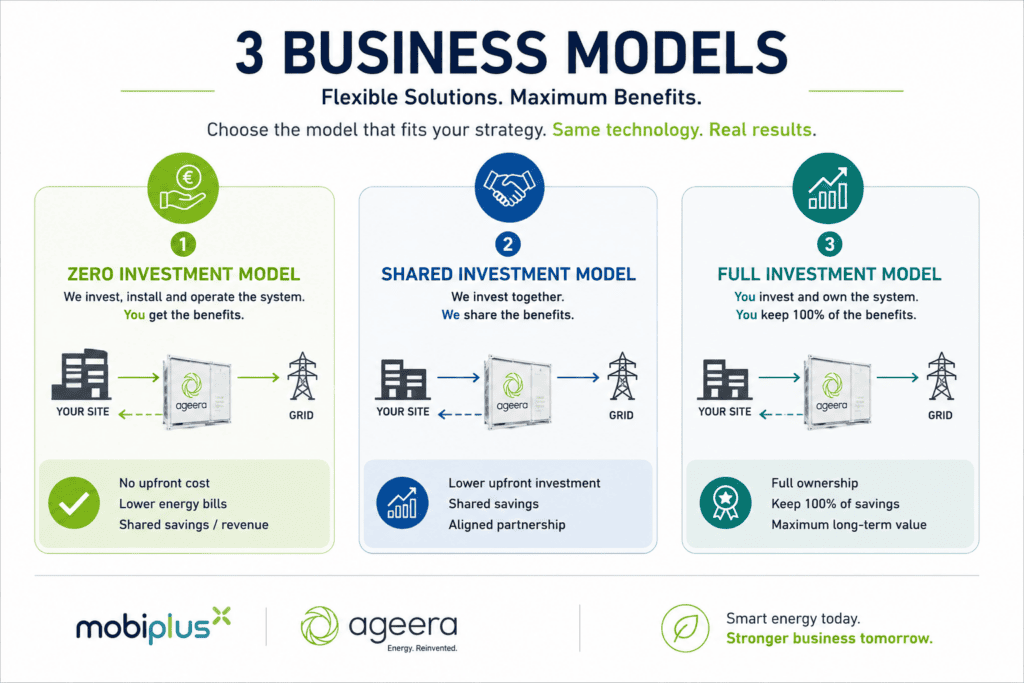
Different customers have different financial preferences. Some want zero capex. Some want to invest partially. Some want to own the asset fully and capture all the benefits. Therefore, the solution can be structured in three main models.
In this model, the customer does not invest upfront in the battery system.
The project is financed by Ageera, investors or a project-finance structure. The battery is installed at the customer’s site, operated by the platform, and the customer receives benefits through reduced energy costs, improved resilience and possibly shared revenue from flexibility.
This model is attractive for companies that want energy savings without allocating capital expenditure. It allows the CFO to evaluate the project as an operating improvement rather than a major investment.
The customer provides the site, the load profile, the energy data and the long-term commitment. The solution provider finances, installs, manages and optimizes the system.
The value is then shared according to a commercial agreement.
For many Greek companies, this will be the easiest way to start.
In this model, the customer participates with part of the investment and receives a larger share of the financial benefits.
This may be suitable for companies that want stronger participation but prefer not to take the full technical and financial risk.
For example, the customer may co-invest in the system, while Mobiplus–Ageera provides technology, optimization, implementation support, maintenance and long-term operation. The profits from savings, peak shaving, arbitrage and flexibility can then be shared based on the investment structure.
This model aligns both sides.
The customer has ownership interest and receives higher upside.
The technology partner remains responsible for performance and optimization.
Both parties benefit when the system performs better.
In this model, the customer funds the entire project and receives all the financial benefits.
This is suitable for companies with strong balance sheets, long-term energy strategy and a desire to own their energy infrastructure.
The customer buys or funds the battery system, while Mobiplus–Ageera provides the software, implementation support, energy optimization, monitoring, maintenance coordination and VPP management.
The customer keeps the full savings and revenue, while paying for technology, software and support services.
This model may be attractive to large groups that want to control their own energy assets, especially if they have many sites and a long-term energy-transition strategy.
There is no single answer.
The right model depends on the customer’s financial strategy, site ownership, electricity consumption, balance sheet, risk appetite, expected savings, project size and internal investment policy.
That is why the first step is not a sales proposal.
The first step is a feasibility study.
We need to understand the site, the load, the electricity cost, the peak demand, the contracted power, the solar potential, the backup needs and the available space. Then we can estimate the financial benefit and propose the best commercial model.
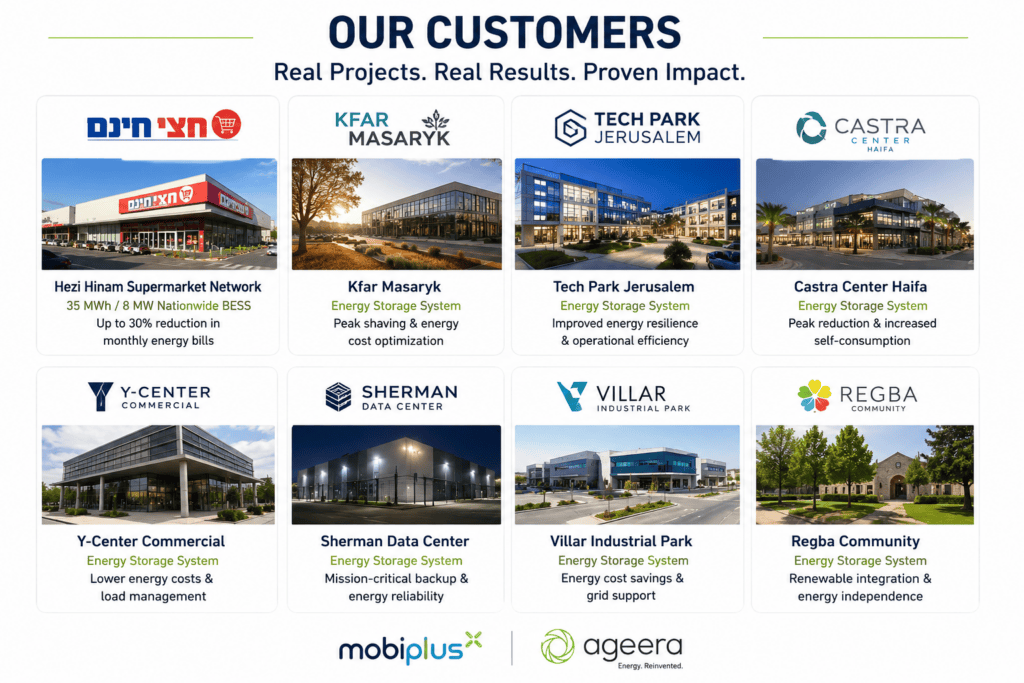
Ageera’s real-world deployments show that the technology has already moved beyond theory.
One of the most important references is the Hezi Hinam supermarket network in Israel. This is a nationwide BESS deployment across a leading supermarket chain, with a total scale of 35 MWh and 8 MW.
The project demonstrates how retail energy infrastructure can become a distributed storage platform. According to the project reference, peak-shaving delivered up to 20–30% reduction in monthly energy bills, while the system also supported backup power and smarter energy use.
This is highly relevant for Greece because supermarket chains have similar energy challenges: refrigeration, air conditioning, lighting, operating-hour peaks, solar potential, grid constraints and the ability to aggregate many sites into one portfolio.
Another reference is Sherman Data Center, a mission-critical energy environment where battery storage and AI-managed energy systems are used to improve resilience, renewable-energy utilization and cost efficiency. Data centers are among the most demanding energy users. If the technology can operate in that environment, it demonstrates credibility for other critical facilities.
Tech Park Jerusalem is another example of a large commercial and research campus where behind-the-meter storage supports energy resilience and renewable integration. This type of project is relevant for Greek technology parks, university campuses, business parks and large commercial real-estate sites.
Other references include Kfar Masaryk, Castra Center Haifa, Y-Center Commercial, Villar Industrial Park, Regba Community and additional projects across retail, industrial, community and commercial environments.
The important point is that the solution has been applied across different types of energy users:
Retail networks
Commercial centers
Industrial facilities
Data centers
Technology parks
Communities
Mission-critical sites
This diversity matters because every Greek customer will ask: “Has this been done before in a business like mine?”
The answer is yes: the model has been applied in real operating environments, not only in laboratory or pilot conditions.
Supermarkets are one of the most interesting sectors for AI-managed battery storage.
A supermarket has constant refrigeration load. It has lighting, HVAC, ovens, compressors, freezers, POS systems, security systems and customer comfort requirements. It often operates long hours. It may have high summer peaks. It may have roof or parking space for solar PV. It may want EV chargers. It may have many stores, which means the portfolio can later become a Virtual Power Plant.
For a single store, the battery can reduce peaks, store solar energy, support refrigeration and lower electricity cost.
For a chain, the opportunity is much bigger.
If 50 or 100 stores have batteries, they can be optimized together. Some stores may discharge when prices are high. Some may charge when solar is available. Some may stay reserved for backup. Some may participate in flexibility programs. The entire chain becomes a distributed energy platform.
This is exactly the type of transformation that CEOs and CFOs should consider.
The question is no longer simply: “How much does this store pay for electricity?”
The question becomes: “How can our national store network become an energy asset?”
Factories often have high power demand, large motors, compressors, production lines, refrigeration, steam, pumps, HVAC and sometimes unstable load patterns.
A factory may have a normal demand of 1 MW but short peaks of 1.5 MW or 2 MW. These peaks can increase costs and create grid-capacity issues. A battery can discharge during those periods and reduce the peak seen by the grid.
A factory may also have production schedules that create predictable energy patterns. AI forecasting can learn these patterns and optimize battery operation.
If the factory has solar PV, the battery can store excess solar production and use it during expensive or high-demand hours.
If the factory has downtime risk, the battery can support critical loads and reduce operational exposure.
For industrial companies, energy storage is not only an ESG investment. It can be a productivity and competitiveness investment.
Greek hotels and resorts have strong seasonal energy patterns. During summer, air conditioning, pools, kitchens, lighting, laundry, water systems and guest services create high demand. Many properties also have solar potential.
A battery can help hotels reduce peak demand, increase solar self-consumption and improve resilience for critical operations.
For high-end hotels, the guest experience is also important. Power interruptions, poor cooling or operational disruption can affect reputation. Energy storage can become part of the hotel’s quality and sustainability strategy.
The best candidates are large hotels, resorts, conference hotels and hotel groups with multiple properties.
Data centers, hospitals, telecom facilities and mission-critical infrastructure have a different value logic.
For them, energy cost matters, but reliability matters even more.
A short power problem can create major operational risk. Batteries are already part of the resilience architecture in many critical environments, but AI-managed BESS can add a new layer of value by combining backup, energy optimization, solar integration and peak management.
As AI and digital infrastructure grow, electricity demand from data centers will become more important. Greece will need reliable, intelligent and flexible energy solutions for this sector.
1. High electricity consumption
Your company is a good candidate if electricity is a major cost — for example factories, supermarkets, cold storage, logistics centers, hotels, data centers, hospitals, industrial parks or large commercial buildings.
Good sign: annual electricity cost above €150k–€300k, and especially above €500k.
2. Peak demand or grid-capacity problem
There is strong potential if your site has high demand peaks, limited contracted power, or difficulty getting more power from the grid for expansion, EV chargers, refrigeration, production lines or new equipment.
Good sign: your maximum demand is close to your agreed/contracted power, or grid upgrade is expensive/slow.
3. Solar, storage or flexibility opportunity
The business case becomes stronger if you already have solar PV, plan to install solar, or want to store cheap energy and use it when prices are higher.
Good sign: you want to increase solar self-consumption, reduce expensive peak-hour energy, or participate in future flexibility/demand-response revenues.
4. Need for reliability and operational protection
The solution is valuable if power interruptions or poor power quality can damage operations, products or service quality.
Good sign: refrigeration, production, data systems, logistics, hotel operations or other critical loads must continue running reliably.
The first step is a short meeting with the CEO, CFO, facility manager, energy manager or technical director.
The objective is to understand whether one or more sites are good candidates.
For each site, we need to review:
Annual electricity consumption
Annual electricity cost
12 months of electricity bills
15-minute or hourly load profile
Peak demand
Contracted power
Connection voltage level
Transformer size
Solar PV installed or planned
Generator or UPS systems
Power outage history
Critical loads
Available space
Expansion plans
EV charging plans
Ownership or lease status
The most important technical document is the load profile. It shows exactly when the site consumes electricity. The battery business case depends on timing: when the site has peaks, when prices are high, when solar is available, and when the battery can create value.
With this data, the system can simulate how a battery would have operated during the previous year. This allows us to estimate savings, size the system, identify the best use cases and recommend the right commercial model.
A typical process can follow six steps.
Step one is site qualification. We identify whether the company has the right energy profile and whether the site is large enough to justify a project.
Step two is data collection. We collect electricity bills, load profile, contracted power, transformer data, solar information and operational requirements.
Step three is simulation. Ageera’s technology models the battery operation and estimates the financial value.
Step four is commercial structure. We decide whether the project should be zero-investment, co-investment or customer-funded.
Step five is engineering and implementation. The battery, inverter, EMS controller, metering, communications and safety systems are designed and installed.
Step six is long-term operation. The system is monitored, optimized, reported and improved continuously.
This long-term operation is critical. The value of a battery is not created only on installation day. It is created every day through intelligent operation.
Mobiplus brings the Greek local support.
The Greek customer needs a local partner that can understand the business case, open discussions with management, coordinate Greek engineers, support implementation, work with energy-market partners, and provide local after-sales support.
Mobiplus brings technology background, sales and market-development experience, AI orientation, local business relationships, engineering contacts and the ability to build a Greek implementation and support ecosystem.
The vision is to combine Israeli innovation with Greek market execution.
This is important because advanced energy storage is not just a product. It is a long-term infrastructure and software partnership.
The customer needs confidence that the system will be supported locally, that engineers will be available, that performance will be monitored, and that the business case will be measured.
For the CEO, the solution supports competitiveness, resilience, sustainability and growth.
It helps the company reduce exposure to energy volatility. It supports expansion when grid capacity is limited. It improves operational reliability. It strengthens ESG positioning. It can create new revenue opportunities.
For the CFO, the solution creates a direct financial case.
The company may reduce energy costs by up to 30%, depending on the site profile and use cases. It may avoid or delay grid upgrade costs. It may improve the return on solar investment. It may create flexibility revenue. It may access a zero-upfront-investment model that does not require major capital expenditure.
For the technical director, the solution improves control.
The site becomes measurable, predictable and optimized. The battery is not isolated hardware. It is integrated into an energy-management system that monitors performance, protects the asset and supports operations.
For the sustainability manager, the solution creates measurable ESG impact.
It increases renewable-energy use, reduces grid stress, supports energy efficiency and provides real data for reporting.
The biggest opportunity is not one battery at one site.
The bigger opportunity is the portfolio.
A supermarket chain with 50 batteries.
A hotel group with 20 properties.
An industrial group with 10 factories.
A logistics company with many warehouses.
A property owner with multiple commercial buildings.
When these assets are connected through software, they become a Virtual Power Plant.
This is where the market is going.
In the future, companies will not only consume electricity. They will manage flexibility. They will store energy. They will support the grid. They will optimize across sites. They will create financial value from their energy behavior.
This is why the Mobiplus–Ageera solution should be seen as a strategic platform, not a single project.
The practical first step is simple.
Select one or more candidate sites. Share basic energy data. Run an initial feasibility study. Estimate the financial benefit. Decide the best investment model.
A good first pilot could be:
One logistics or cold-storage site.
One large supermarket or retail site.
One factory with high peak demand.
One hotel or resort with seasonal load and solar potential.
One data center or critical facility.
After the first pilot, the model can be expanded to more sites.
This allows the customer to start with evidence, not theory.
The energy transition is not only about producing more renewable energy. It is also about using energy intelligently.
For Greek commercial and industrial companies, the next competitive advantage will come from managing energy dynamically: storing it, forecasting it, shifting it, optimizing it and monetizing it.
Mobiplus and Ageera bring to Greece a proven Israeli energy-storage and AI optimization platform that can help companies reduce costs, protect operations, improve sustainability and create new revenue opportunities.
With flexible financing models, including zero upfront investment for qualified customers, this opportunity becomes practical and accessible.
The companies that move first will not only reduce electricity costs. They will build smarter, more resilient and more valuable energy infrastructure for the future.
We would be pleased to meet with Greek CEOs, CFOs and energy teams to estimate the exact financial benefit for their company and identify the best first sites for a feasibility study.

Test out the Recommendation Engine for up to 20.000 euros in revenue from recommendations. No credit card required. Just enter your company information and we’ll contact you with all the details.
