Empower Your Business With The Magic Of Machine Learning!
- +30 210 9701777
- Aristotelous 83, Athens 163 43
- contact@mobiplus.co

Empower Your Business With The Magic Of Machine Learning!
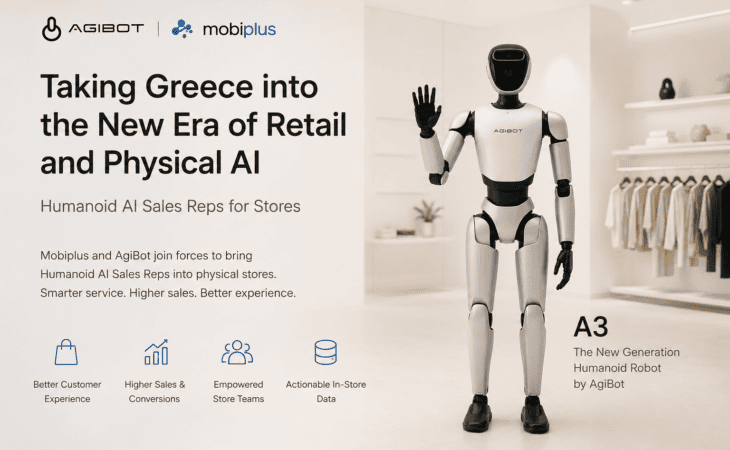
Mobiplus took part in the AGIBOT European launch for humanoid robots and organized with the management team the next era of retail for Europe: the era of Humanoid AI Sales Reps for Stores
For many years, retail innovation has been focused mainly on e-commerce, mobile apps, loyalty platforms, recommendation engines, digital signage and self-service kiosks.
But the next major transformation will not happen only on the screen.
It will happen inside the physical store.
It will happen in the aisle.
It will happen in front of the shelf.
It will happen at the exact moment when the customer is trying to decide what to buy.
And this is where Humanoid AI Sales Reps for Stores will change the future of retail.
At Mobiplus, we have been developing AI retail technology for years: recommendation engines, shopping personalization, AI sales conversations, product intelligence, customer preference modeling and architecture that connects directly with a retailer’s ERP, e-shop and product database.
AGIBOT is the leading humanoid robot platform, the physical presence, the mobility and the advanced technology to teach the robot how to understand the store environment: the shelves, the products, the sections, the aisles and the physical shopping space.
Together, this creates something very powerful:
A humanoid AI Sales Rep that can understand the customer, understand the store, understand the products, speak naturally, recommend intelligently and guide the customer to the right shelf.
This is not science fiction.
This is retail Now !
Retail stores across Europe are facing a very clear set of challenges.
First, it is becoming harder and harder to find and retain salespeople.
Retail is a demanding environment. Stores need people during long opening hours, weekends, seasonal peaks, promotional periods and busy customer traffic moments.
At the same time, labor costs are increasing and younger employees often do not see store sales as a long-term career path.
Second, product knowledge is becoming a major gap. In many sectors, the number of products has exploded. A DIY store may carry thousands of products across paint, tools, electrical, plumbing, gardening, home improvement and building materials.
A sports store may carry hundreds of shoes, apparel items, equipment types and technical products.
An electronics store may carry multiple product categories, brands, models and technical specifications.
No human salesperson can easily remember everything.
They may know one brand well, but not all alternatives. They may be strong with experienced customers, but less confident with technical questions.
Sometimes the customer knows more than the salesperson because they have already searched online.
Third, stores lose sales because customers cannot find help at the right moment.
A customer may enter the store, look for a product, fail to understand the difference between options, become confused, wait for assistance, and then leave. In many cases, the store never even knows that a sale was lost.
Fourth, retailers need more data from the physical store. In e-commerce, we know what customers search, click, compare, add to cart and abandon.
But in the physical store, many customer intentions disappear. The retailer does not know what the customer asked, what product they could not find, what concern stopped them from buying, what alternative they wanted, or what information they needed.
This is a huge lost opportunity.
The physical store has always been rich in human interaction, but poor in structured data.
Humanoid AI Sales Reps can change that.
They can serve the customer, support the staff, increase sales and create a new data layer inside the store.
A Humanoid AI Sales Rep is not just a robot walking inside a store.
It is the combination of three technologies:
1. The humanoid robot platform
The robot can move, approach customers, interact naturally, guide them to shelves and operate inside the physical store environment.
2. The retail intelligence layer
Mobiplus connects to the retailer’s ERP, e-shop, product database, purchase history and product availability.
This gives the humanoid access to real product data, prices, stock, product characteristics, alternatives and customer preferences.
3. The conversational AI sales layer
The humanoid uses LLM technology to create a natural sales conversation. It can ask questions, understand the customer’s need, explain product differences, recommend the right product and guide the customer toward a purchase decision.
This is where the real value is created.
The humanoid is not only “moving.”
It is selling.
It is advising.
It is recommending.
It is learning.
It is collecting structured customer intent.
It is becoming part of the store’s commercial infrastructure.

For a CEO, this is not only a technology project.
It is a strategic retail transformation project.
Physical retail is under pressure from e-commerce, marketplaces, delivery platforms and price comparison engines. Stores must offer something that online cannot easily replicate: immediate experience, personal guidance, physical product discovery and trusted advice.
But to do this at scale, stores need a new layer of intelligence.
Humanoid AI Sales Reps can make every store smarter, more interactive and more efficient.
For a COO, this creates a way to support store operations, reduce pressure on staff and improve service consistency.
For a CMO, it creates a new brand experience, a powerful innovation story and a differentiated customer journey.
For a CIO or CTO, it creates a new AI infrastructure layer connected to existing ERP, e-commerce and data systems.
For a CFO, it creates measurable benefits: higher conversion, higher basket value, better staff productivity and new data-driven optimization.
For the Board, it creates a strong message:
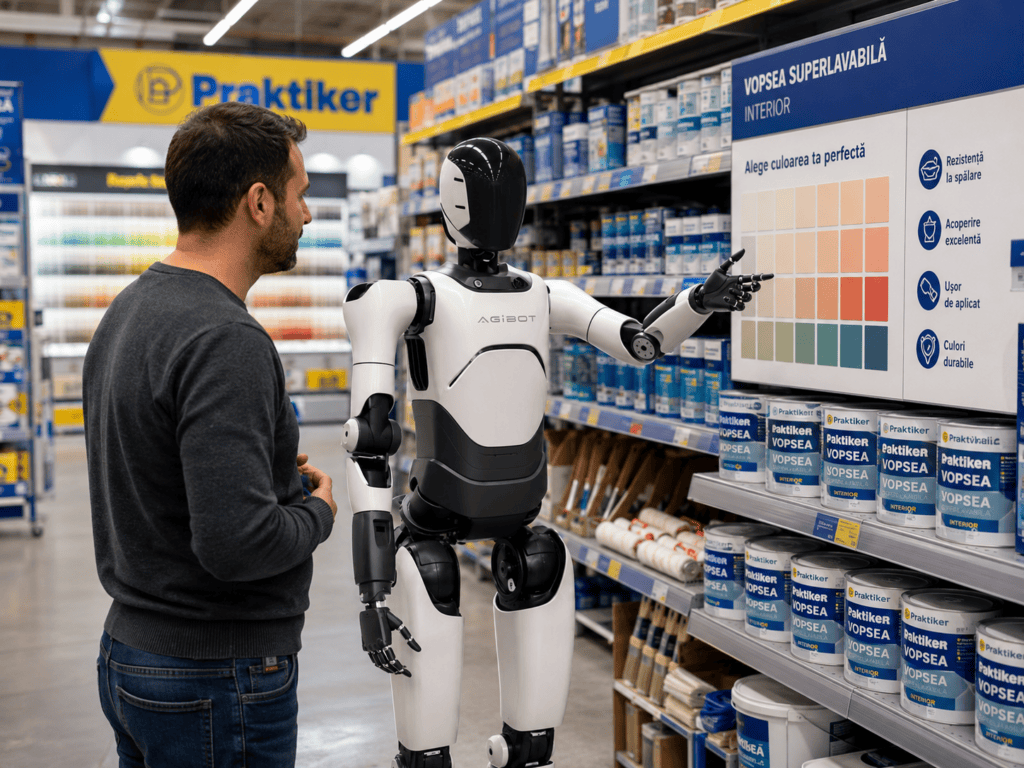
Let us imagine a practical example.
A large DIY retailer wants to start with one section: paints.
This is an ideal first use case because the paint category has high customer need, technical complexity and strong cross-sell potential.
A customer enters the paint section.
They are standing in front of a large shelf with dozens of paint types: interior paint, exterior paint, washable paint, anti-mold paint, primer, enamel, wood paint, metal paint, ceiling paint, color options, different brands, different price points and different packaging sizes.
The customer is not sure what to buy.
A humanoid AI Sales Rep approaches politely and says:
“Hello, can I help you choose the right paint for your project?”
The customer says:
“I want to paint a bedroom.”
The humanoid continues:
“Is it for a child’s room, master bedroom or guest room?”
The customer says:
“It is for a child’s room.”
The humanoid asks:
“Do you need washable paint? Is there any humidity or mold issue? Do you prefer a low-odor or eco-friendly option? How many square meters is the room?”
The customer answers:
“It is about 18 square meters. I want something washable and safe.”
At this point, the humanoid AI Sales Rep connects the conversation with the product intelligence layer.
It checks the retailer’s ERP or product database.
It understands available stock.
It checks paint types, product descriptions, technical characteristics, price, packaging size and possible complementary products.
Then it responds:
“For a child’s room of 18 square meters, I recommend this washable, low-odor interior paint. You will need approximately two cans, depending on the number of coats and the wall condition. I also recommend a primer if the wall has not been painted recently.”
Then the humanoid can show the product on its screen, explain why it is suitable, compare it with a more premium alternative and a more economical alternative, and recommend the correct brush, roller, masking tape, tray and protective floor cover.
This is where the sales value becomes very clear.
A human salesperson might simply sell one paint can.
The humanoid AI Sales Rep can recommend the complete project basket.
Paint.
Primer.
Roller.
Brush.
Masking tape.
Tray.
Protective cover.
Cleaner.
This increases the average basket and improves the customer’s confidence.
Then the customer says:
“Can you show me where it is?”
The humanoid says:
“Of course. Please follow me.”
It guides the customer to the correct shelf, stops in front of the product location and says:
“This is the product I recommend. The 10-liter package is here. The primer is on the shelf below, and the roller set is two meters to your right.”
If needed, the humanoid can notify a human sales associate:
“Customer in paint section needs help with color mixing for washable paint.”
The human employee then joins at the right moment, with the right context.
This is not replacing the human.
This is making the human more effective
One of the most important points we must make clear is this:
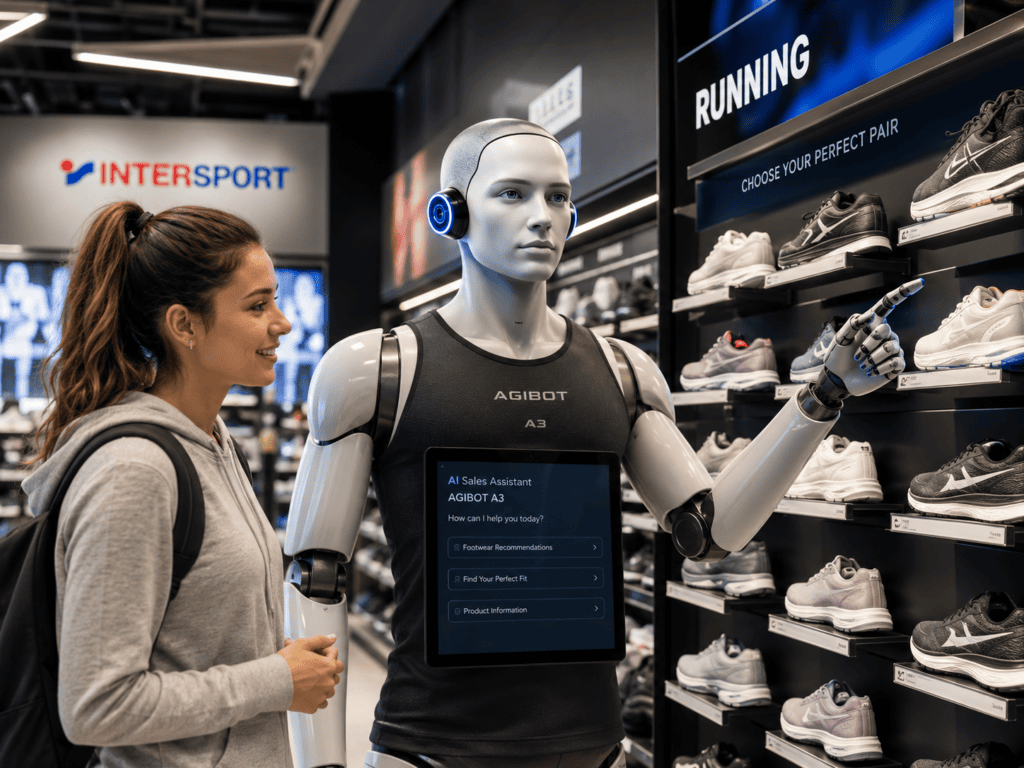
Humanoid AI Sales Reps are not designed to replace human salespeople. They are designed to augment them.
Retail will always need people.
Customers still want human contact, trust, empathy and relationship. Especially for complex decisions, high-value purchases or emotional buying moments, the human salesperson remains critical.
But today, salespeople spend too much time answering repetitive questions:
“Where is this product?”
“Do you have size 42?”
“What is the price?”
“Is this available?”
“What is the difference between these two?”
“Which product do I need for this simple job?”
The humanoid AI Sales Rep can handle many of these first-level and second-level questions.
This frees the human staff to focus on higher-value tasks:
building relationships, closing important sales, helping complex customers, managing store presentation, solving exceptions and improving the customer experience.
The best model is not AI instead of humans.
The best model is:
AI + human sales team.
The humanoid collects the need, structures the request, recommends the product and calls the human when the human can add real value.
This makes the entire store team more productive.
For CEOs and CFOs, the financial case is very important.
Humanoid AI Sales Reps can create value in several measurable ways.
1. Higher conversion
Many customers enter stores with intent but leave without buying because they cannot find the right product or cannot get advice quickly. A humanoid AI Sales Rep can engage customers at the point of hesitation and convert more visits into purchases.
2. Higher average basket
Because the AI understands the full project need, it does not recommend only one product. It recommends the complete solution.
In the paint example, this means not only paint, but also primer, tools and accessories.
In electronics, this could mean device, cable, case, warranty and installation service.
In sports, this could mean shoes, socks, insoles, clothing and accessories.
3. Better staff productivity
The humanoid handles repetitive questions and guides customers before a human salesperson is needed. This reduces pressure on staff and improves service coverage, especially during busy hours.
4. Better product knowledge consistency
Every customer receives high-quality advice based on the same product data, technical descriptions and recommendation logic. This reduces the risk of wrong advice, incomplete explanations or missed cross-sell opportunities.
5. Better data from the physical store
Retailers can finally understand what customers ask in-store:
What are they looking for?
Which products confuse them?
Which categories need better explanation?
Which products are requested but out of stock?
Which recommendations convert?
Which questions lead to lost sales?
This data can improve merchandising, purchasing, training, marketing and inventory planning.
6. Stronger innovation image
For large retailers, being first in Physical AI creates a powerful market signal. It shows customers, employees, investors and partners that the company is moving first into the next generation of retail.
The right approach is not to start with the whole store.
The right approach is to start with one high-value section.
For a DIY retailer, this could be paints.
For an electronics retailer, it could be home appliances.
For a sports retailer, it could be running shoes.
For a pharmacy or beauty retailer, it could be skincare.
For a furniture retailer, it could be mattresses or sofas.
The first section becomes the pilot.
We train the humanoid to understand the space, the shelves, the products and the sales logic of that category.
We connect to the ERP and e-shop data.
We create the conversational flows.
We activate recommendation logic.
We define KPIs.
We measure performance.
Then we expand to the next section.
This creates a practical, low-risk path:
One section → one store → multiple sections → multiple stores.
This is how retailers can adopt humanoid AI without disrupting operations.
Mobiplus brings the retail AI intelligence layer.
We already have a working architecture that connects with the retailer’s ERP and e-shop, receives product data, purchase data and customer preferences, and uses recommendation technology to identify the most relevant products for each customer.
We bring the AI sales conversation.
We bring the recommendation engines.
We bring the architecture for product intelligence.
We bring the logic that allows the humanoid to move from a simple conversation to a commercial recommendation.
We understand retail data.
We understand shopping behavior.
We understand how to increase sales through personalization.
AGIBOT brings the leading humanoid robot platform in the world !
The humanoid can operate in the physical store environment.
With AGIBOT’s technology, including the tools to teach the humanoid to understand spaces, shelves, products and store sections, the robot becomes much more than a screen with wheels.
It becomes a physical AI assistant inside the store.
The Mobiplus team can train the humanoid to understand the retail environment: where products are, how shelves are organized, how sections are structured, and how to guide the customer inside the store.
This combination of physical intelligence and retail intelligence is what makes the solution powerful.
For the last 20 years, retail innovation was mainly digital.
The next 10 years will bring AI back into the physical world.
AI will not only recommend products on websites.
AI will walk inside stores.
AI will speak with customers.
AI will understand shelves.
AI will guide shoppers.
AI will support staff.
AI will collect in-store intent.
AI will help retailers understand what is really happening in the physical shopping journey.
This is the meaning of Physical AI in retail.
And it is starting now.
If you are a retail CEO, CMO, COO, CIO, CTO or Board Member, the question is no longer whether AI will enter the store.
It will.
The real question is:
Will your company lead this transformation, or will you wait until competitors define the new customer experience?
Humanoid AI Sales Reps are not a gimmick.
They are the beginning of a new retail operating model.
They combine customer service, sales assistance, product knowledge, recommendation intelligence, staff support and data collection into one physical AI interface.
Retailers should not try to implement everything at once.
Start with one section.
Measure the impact.
Learn.
Then scale.
At Mobiplus, together with AGIBOT, we want to help retailers in Greece and Europe explore this new era of AI-powered physical retail.
We would be happy to present how a Humanoid AI Sales Rep could work inside your store, starting from one section and expanding step by step across your retail network.
The future of retail will not be only online.
It will be intelligent.
It will be conversational.
It will be physical.
And it will walk inside your stores.

Test out the Recommendation Engine for up to 20.000 euros in revenue from recommendations. No credit card required. Just enter your company information and we’ll contact you with all the details.
