Empower Your Business With The Magic Of Machine Learning!
- +30 210 9701777
- Aristotelous 83, Athens 163 43
- contact@mobiplus.co

Empower Your Business With The Magic Of Machine Learning!
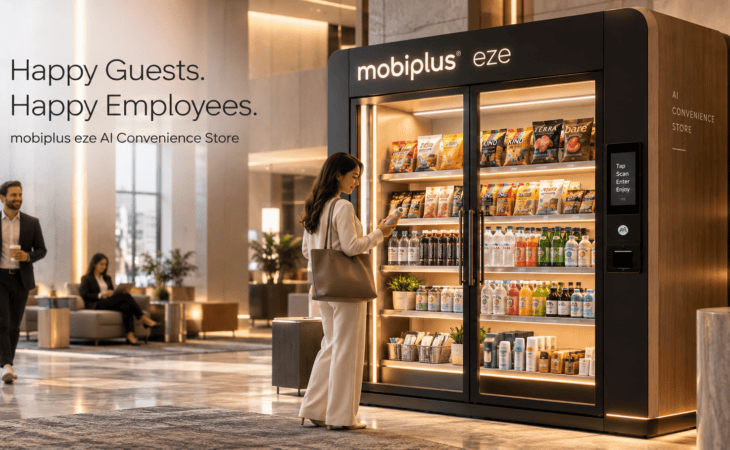
Very often, the greatest value of technology is not found in something spectacular or complicated. It is found in solving a very small need at exactly the moment it appears.
An employee who has been at the office since 08:30 realizes at 14:30 that they have not eaten. An engineer working against a deadline needs a coffee, an energy drink, or something quick to eat at 18:00. A hotel guest returns at 23:30 and wants water, a snack, a charger, or a personal-care item without leaving the hotel again. A resident or visitor in a modern building needs something immediately, but the nearest store is several minutes away.
These are small moments. But these small moments are often what determine whether someone thinks, ‘They really thought about what I might need,’ or ‘Why do I have to go through so much trouble for something so simple?’
This is the problem the mobiplus eze AI Convenience Store is designed to solve.
The mobiplus eze AI Convenience Store is an autonomous, 24/7 retail point that can be installed inside hotels, office buildings, factories, residential developments, mixed-use buildings, and other locations where people work, stay, live, or spend significant amounts of time.
The user experience is simple: Tap – Grab – Pay. The user enters with a card, mobile phone, or another access method, takes the products they need, and leaves. There is no traditional checkout, no barcode scanning, no queue, and no staff required. AI and computer vision identify the selected products and enable a natural, frictionless purchase experience.
But the technology is only the first layer. The real question is: what should be inside? An AI Store filled with the wrong products is simply a sophisticated piece of technology. An AI Store with the right products, in the right quantities, at the right prices and in the right location becomes something very different: a service that genuinely improves people’s everyday experience.
A hotel guest has different needs from a factory employee. A building full of software engineers has different needs from a residential development. A business traveler in central Athens has different moments of need from someone spending eight hours inside a production facility.
That is why the product assortment should always begin with one simple question: Who is the person using this location, and what are they likely to need in the next few hours? That is where the design process begins. Then the AI layer starts learning.
A hotel guest does not judge only the room, the mattress, the lobby, or breakfast. They judge dozens of small moments throughout the stay. They may arrive late and need water. They may have forgotten a charger. They may want a snack after a night out, a personal-care product, a recovery item after walking around Athens all day, or a high-quality Greek gift before leaving for the airport.
These small needs can become friction — or a positive surprise. An AI Convenience Store can operate as a 24/7 guest experience hub.
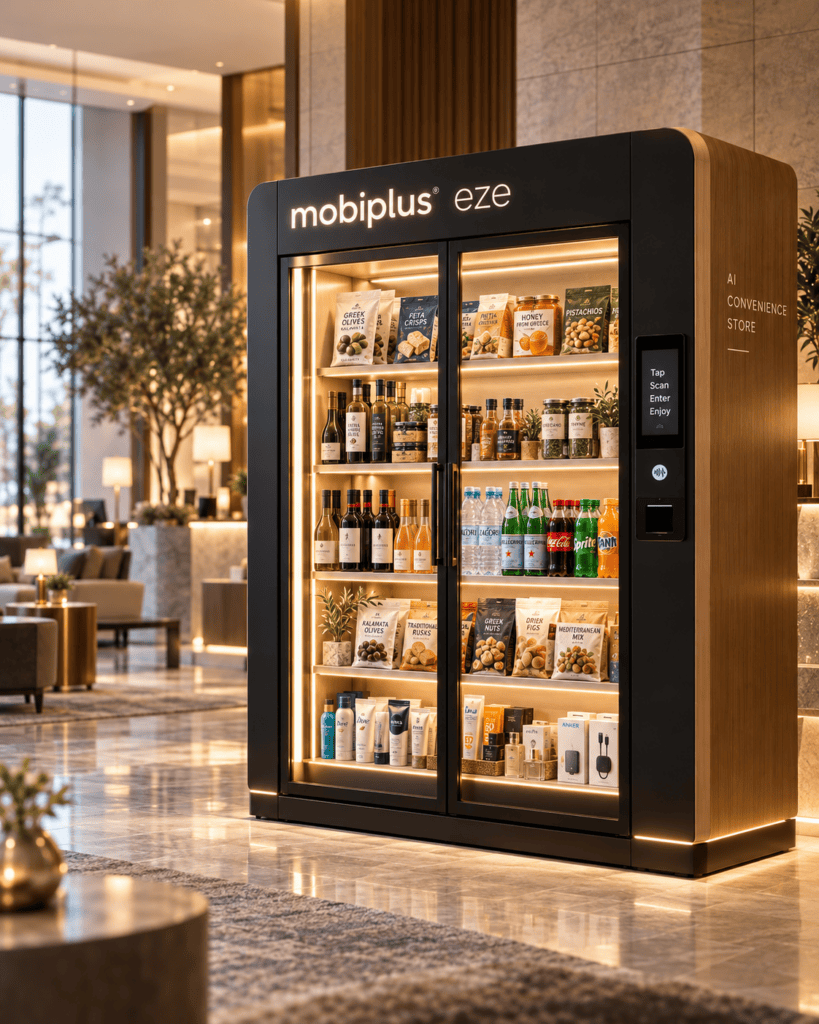
Water, sparkling water, electrolytes, energy drinks, protein drinks, premium snacks, nuts, chocolate, sleep masks, earplugs, and basic personal-care items. The guest does not need to call reception or leave the hotel after midnight. The solution is simply there when needed.
Chargers, USB-C cables, iPhone cables, power banks, adapters, and earbuds. A forgotten charger may be a small issue for the hotel, but a major problem for a guest who has a business meeting the next morning.
Premium olive oil, honey, herbs, local delicacies, snacks, confectionery, cosmetics, and curated gift boxes can transform the store from pure convenience into part of the travel experience. A guest leaving early for the airport can still take a piece of Greece home.
Skincare, hygiene products, wellness items, and discreet personal essentials provide autonomy and privacy. Guests can get what they need without asking for help or feeling uncomfortable.
Why does this make guests happier? Because the hotel appears to have anticipated a need before it became a problem. That feeling of being cared for is one of the most powerful elements of hospitality. The outcome goes beyond store sales: higher satisfaction, fewer small complaints, a stronger perception of service, better reviews, greater likelihood of repeat visits, stronger word of mouth, and greater brand differentiation.
Small moments. Better reviews. Stronger revenue.

In a large corporate building or factory, the problem is different. Employees spend many hours in the same environment, moving between meetings, deadlines, shifts, production tasks, screens, technical work, and short breaks. If getting water, a snack, or a meal requires leaving the building, that creates friction. It costs time, breaks concentration, and may not even be possible during certain shifts.
An AI Convenience Store can operate as a 24/7 employee experience service.
The product mix can be oriented toward productivity and convenience. Morning Start can include cold coffee, cappuccino, protein drinks, protein milk, and light breakfast products. 2 PM Recovery can include sugar-free energy drinks, premium functional beverages, cold coffee, protein bars, and nuts. Deep Work Nutrition can include protein bars, almonds, dried fruit, healthy snacks, and low-sugar alternatives. Lunch & Project Crunch can include ready meals, cook & chill meals, ramen, and other fast meal solutions. Emergency Convenience can include eye drops, tissues, gum, wellness essentials, chargers, cables, and power banks.
The value is not simply that products are available. The store removes small interruptions from the employee’s day. The fewer unnecessary interruptions, the better the everyday work experience.
In factories, the need can be even stronger. Hundreds of employees may work different shifts with limited access to alternatives. A traditional canteen operates during specific hours, requires staff, has operating cost, and may not serve night shifts. An AI Convenience Store can provide water, soft drinks, energy drinks, ready meals, snacks, protein products, personal-care items, and other essentials 24/7.
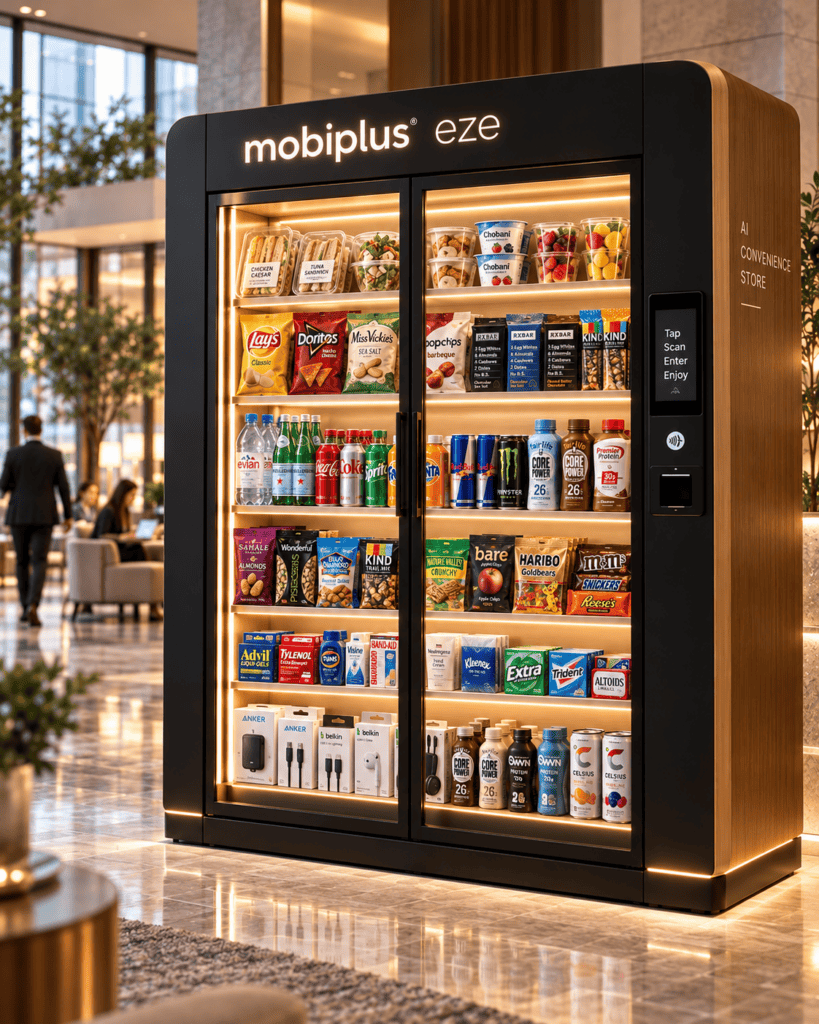
For employees, the benefit is simple: something useful is available when they need it. For the company, the benefits include a better employee experience, support across all shifts, fewer external trips, less lost time, a modern employee benefit, and a stronger image as an employer.
There is another important advantage: installing a state-of-the-art Tap – Grab – Pay AI Store creates a highly visible signal of innovation. Employees do not just read in a corporate presentation that the company invests in innovation — they use that innovation every day.
Developers are in a different position. They are not designing only for today’s user; they are designing buildings that may be used for the next 10, 20, or 30 years. Modern buildings no longer compete only on location, design, energy efficiency, parking, security, or smart access. Increasingly, they compete on experience.
What does the building actually offer the person who works, lives, or stays there? Gyms, EV charging, shared workspaces, smart access, and parcel lockers have become expected amenities. 24/7 AI Convenience Retail can now become another layer.
An AI Store can serve employees and visitors with coffee, hydration, snacks, protein products, ready meals, tech accessories, and emergency items — adding a service layer without the need to operate a staffed convenience store.

The assortment changes: water, milk, breakfast products, snacks, basic household items, personal care, pet essentials, baby essentials, and emergency products. A resident can go downstairs at 23:30 and buy something they forgot instead of getting into a car. That small convenience can become a surprisingly strong part of the building experience.
The store can adapt to several audiences: employees during the day, residents in the evening, visitors, business travelers, and conference attendees. For the developer, the AI Store is not simply a point of sale. It is a building amenity. The more services a building can provide without creating a heavy operating burden, the stronger its value proposition becomes for tenants, buyers, and operators.
The first product mix is only the beginning. Once the AI Store is operating, it begins generating real behavioral data: what users buy, when they buy it, what they buy together, what they do not buy, which products run out first, when traffic peaks, and how behavior changes by day or user profile.
In a hotel, hydration, snacks, and recovery items may increase after 22:00. In a software engineering building, energy drinks and protein snacks may peak around 14:00. In a factory, each shift may behave differently. In a residential building, demand may peak in the late afternoon and evening.
This moves the conversation from ‘What do we think people will want?’ to ‘What are they actually showing us they want?’
Mobiplus has long worked with shopping personalization around one central idea: consumers do not want to search — they want to be guided. The same philosophy can be brought into physical retail.
Using sales and behavioral data, the product mix, quantities, shelf allocation, core assortment, rotating products, pricing, promotions, and replenishment schedule can be continuously optimized.
The next step is prediction: not only understanding what sold yesterday, but forecasting what is most likely to be needed tomorrow. If a project team of 150 engineers will be in a building for three weeks, the assortment can adapt. If a hotel’s guest profile changes seasonally, the product mix can adapt. If particular items show strong spikes at specific times, stock can be increased before a stockout occurs.
The AI Store therefore stops being a static retail installation. It becomes a learning retail ecosystem — one that learns from the people using it.
The objective is not to place more machines inside buildings. It is to create better small moments: the employee who finds a meal without losing 30 minutes, the engineer who finds a charger before an important meeting, the night-shift worker who has access to products when everything else is closed, the hotel guest who finds water or a personal item at 02:00, the tourist who buys a Greek gift before departure, or the resident who goes down two floors instead of driving to a convenience store.
Each of these moments may have a small monetary value as a transaction, but a much larger value as an experience. It creates the feeling that someone thought about what the user might need. That is one of the most powerful forms of customer and employee experience.
For a hotel: guest satisfaction + reviews + differentiation + repeat visits + additional revenue.
For a company or factory: employee experience + productivity + convenience + employer branding + 24/7 service.
For a developer: building differentiation + modern amenities + tenant experience + a stronger property proposition.
And for all of them: state-of-the-art technology that customers and employees do not merely see — they actually use.
Technology alone is not enough. Mobiplus can manage the full fulfillment layer: AI Store infrastructure, product strategy, sourcing, planogram, pricing, replenishment, inventory monitoring, technology support, performance analysis, and continuous assortment optimization.
The customer does not need to become a retailer. They can simply offer the service to the people who use their building.

It will learn. It will adapt. It will predict. It will understand that different people, different buildings, and different times create different needs. And the better those needs are understood, the easier it becomes to create small moments of satisfaction.
Because the future of autonomous retail may not simply be Tap – Grab – Pay.
It is: Understand – Predict – Serve – Delight.
That is the direction of the mobiplus eze AI Convenience Store: a state-of-the-art retail service that is there at the moment people need it — with the right product, at the right price, in the right place — making everyday life a little easier.
Happy guests. Happy employees. Smarter buildings.
Read our book and learn why instore personalization and shopping data is the name of the game.

This is where the real differentiation happens.
🟤 Greek Essentials (Hero Category)
What guests truly want to take home:
👉 authentic, premium, and deeply connected to Greece
🟤 Greek Snack Discovery
For immediate enjoyment:
👉 small purchases that create memorable moments
🟤 Greek Gifting Experience
High-margin, emotional purchases:
👉 “I didn’t plan to buy this… but I love it”
🟤 Sweet Greek Indulgence
👉 emotional connection through taste
Supporting—not leading—the experience:
👉 covering needs without diluting the premium identity
1. Elevated Guest Experience
Guests feel:
👉 “Everything I needed was right here”
2. Stronger Reviews & Ratings
This translates into:
3. True Differentiation
You are no longer just a hotel.
👉 You become:
an experience destination
4. 24/7 Service with Zero Operational Burden
5. New Revenue Stream
Supporting Greek Producers
👉 small and premium producers gain global exposure
Tourism as Export Channel
Guests:

Strengthening “Brand Greece”
👉 every product becomes a cultural ambassador
Your guest is not just a customer.
👉 They are a global connector.
They:
👉 creating organic international expansion
❤️ Emotional Impact
You are not selling products.
👉 You are creating:
And that leads to something far more valuable than a purchase:
👉 loyalty
🔁 Repeat Visits
Guests:
👉 and they come back
Most hotels compete on:
You shift the game to:
👉 experience
🚀 The Future of Hospitality
Hotels will no longer be judged only by:
👉 but by:
how much they enrich the guest’s life

An AI Smart Store focused on premium Greek products:
👉 And most importantly:
it transforms your hotel into something guests never forget
If you would like to explore how this can be implemented in your hotel:
👉 a short conversation is worth it
Because this is not just another amenity.
👉 It is the next level of hospitality.

Test out the Recommendation Engine for up to 20.000 euros in revenue from recommendations. No credit card required. Just enter your company information and we’ll contact you with all the details.
