Empower Your Business With The Magic Of Machine Learning!
- +30 210 9701777
- Aristotelous 83, Athens 163 43
- contact@mobiplus.co

Empower Your Business With The Magic Of Machine Learning!
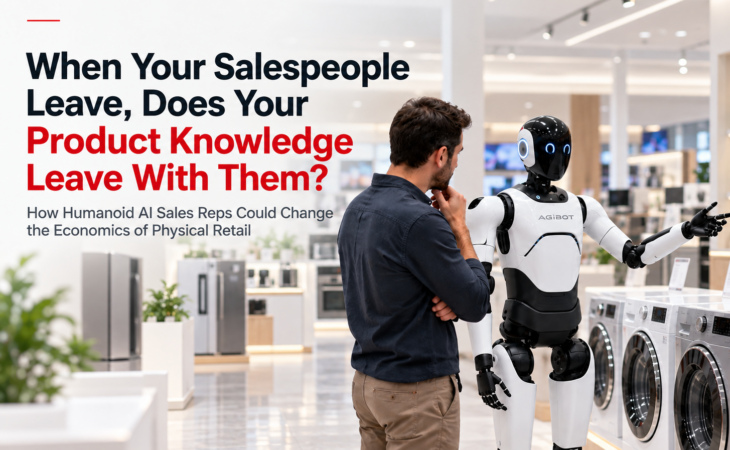
Retailers have spent the last decade investing heavily in e-commerce, recommendation engines, ERP systems, product information management, loyalty platforms, AI assistants and increasingly sophisticated customer analytics.
But walk into a physical store and one fundamental problem remains surprisingly unchanged:
The quality of the customer experience still depends heavily on which salesperson happens to be available at that moment.
This becomes especially difficult in categories such as consumer electronics, home appliances, DIY, furniture and sporting goods.
The product ranges are large.
The specifications change constantly.
Promotions change.
Stock changes.
Customers arrive already informed from the internet.
And the salesperson is expected to understand all of it.
At the same time, retailers face high employee turnover.
They recruit people.
They train them.
Those employees slowly build product knowledge.
And then many leave.
The knowledge leaves with them.
A new person comes in and the cycle begins again.
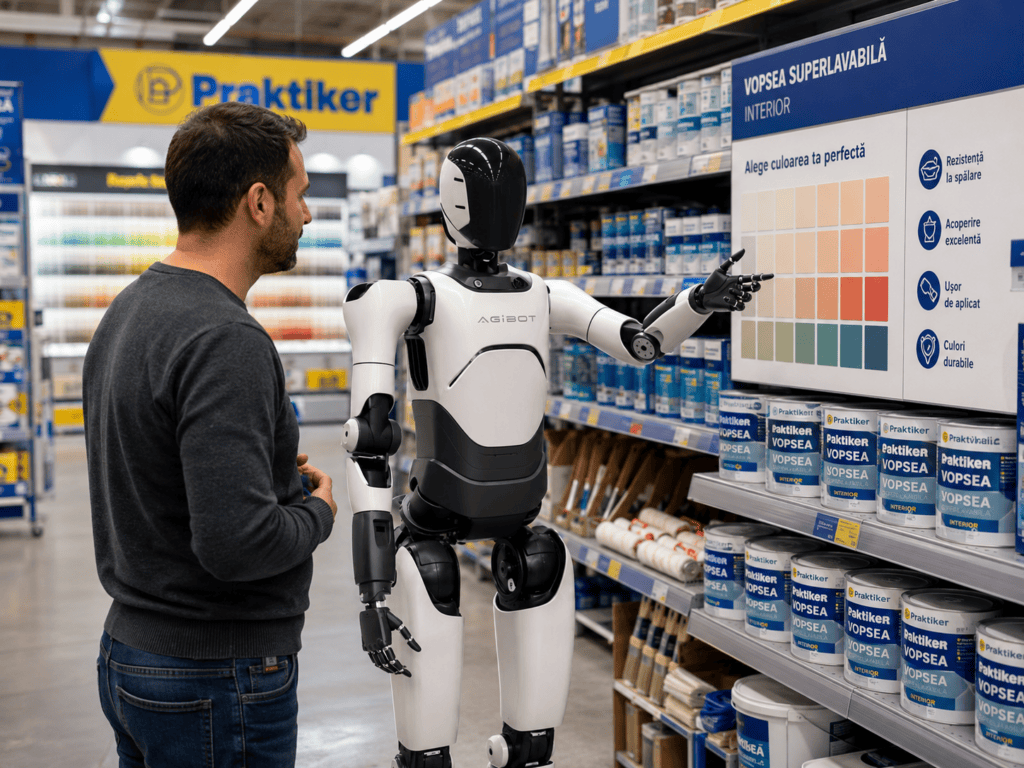
The result is not simply an HR problem.
It becomes a sales, customer-service and profitability problem.
The customer doesn’t care about your staffing problem
Imagine a customer walking into an electronics store looking for a washing machine.
She asks:
“I have a family of four. I want something quiet, energy efficient, under €700, and I need delivery next week. What should I buy?”
There may be 40 washing machines in the department.
Different capacities.
Different energy ratings.
Different noise levels.
Different brands.
Different promotions.
Different warranties.
Different availability.
Perhaps the salesperson has worked in the department for five years and gives an excellent answer.
Perhaps he started three weeks ago.
Perhaps the appliance expert is helping another customer.
Perhaps the employee simply says:
“Let me find someone who knows.”
From the retailer’s perspective, these are staffing realities.
From the customer’s perspective, there is only one conclusion:
And the customer may leave.
Or check the product online.
Or buy from a competitor.
This is the structural problem.
Retailers increasingly expect frontline employees to understand thousands of SKUs and answer questions covering:
This becomes even harder in DIY.
A customer may not even know what product they need.
They may say:
“I want to paint a bedroom.”
That is not a product request.
It is a project.
The salesperson needs to understand:
How large is the room?
What surface?
Is there humidity?
Does it need primer?
What kind of paint?
How many litres?
Which roller?
Which brush?
Masking tape?
Floor protection?
Preparation material?
The best salesperson doesn’t simply find a product.
They build the customer’s complete solution.
But maintaining that level of expertise across hundreds of employees, many categories and many stores is expensive and difficult.

This is where humanoid AI becomes interesting.
Not because robots look futuristic.
Not because customers may stop and take photographs.
And certainly not because a humanoid can dance.
The interesting business question is much simpler:
What if every store could have a permanent product expert that never forgets the catalogue, always knows the latest information, understands customer needs and is connected directly to the retailer’s systems?
A Humanoid AI Sales Rep can potentially combine:
The robot becomes the physical interface to the retailer’s existing digital intelligence.
That distinction is important.
Large retailers often already have sophisticated technology.
They do not need another isolated AI platform.
They may already have:
ERP.
PIM.
Stock systems.
Product search.
Recommendation engines.
Knowledge bases.
AI assistants.
Customer apps.
The Humanoid AI Sales Rep can sit on top of that infrastructure and bring it into the aisle.
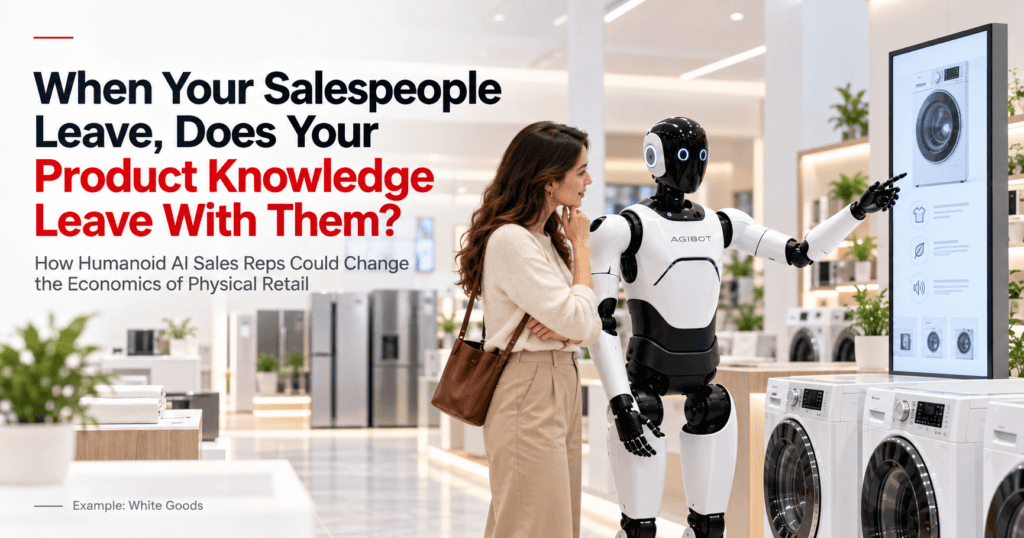
The customer says:
“I need a washing machine for a family of four.”
The Humanoid AI Sales Rep asks:
“What capacity do you prefer?”
“What is your budget?”
“Is low noise important?”
“Would you prefer the most energy-efficient model?”
“Do you need installation and removal of your old appliance?”
The retailer’s recommendation engine identifies three suitable models.
The ERP confirms:
price,
availability,
promotion,
delivery.
The robot explains:
“This model is the best value.
This one uses less energy.
This one is more expensive but is quieter and has a larger capacity.”
Then:
“The first two are available in this store. Would you like me to show you where they are?”
The humanoid guides the customer to the appropriate display area.
If the customer then asks:
“Can I finance this over 12 months?”
the robot can hand the session to a human salesperson.
But crucially, the human does not begin from zero.
They receive the context:
family of four,
€700 budget,
quiet operation,
three products recommended,
interested in financing.
The human can now do what humans do best:
build trust,
answer complex questions,
negotiate,
reassure,
and close the sale.
We should be realistic.
If humanoid AI becomes commercially successful, it will not simply be added on top of today’s store staffing model forever.
Part of the economic value will come from lower labour cost.
Many store tasks are repetitive:
“Where is this product?”
“Is it in stock?”
“What is the difference between these models?”
“Which one is cheaper?”
“What accessories do I need?”
“What is the warranty?”
“What aisle is this in?”
These tasks do not always require a highly paid human expert.
Our working hypothesis is that in some retail formats humanoid AI could eventually allow stores to reduce perhaps around 20% of low-value frontline roles.
That figure must be proven through pilots.
It should not be treated as a guarantee.
But the direction is important.
The goal should not be:
The better model may be:
fewer salespeople — but better salespeople.
A smaller number of human employees can be:
better trained,
better paid,
more knowledgeable,
more enthusiastic about the category,
and focused on situations where human capability matters.
That includes:
complex projects,
high-value sales,
negotiation,
empathy,
exceptions,
professional advice,
and closing.
Humanoids handle repetitive volume.
People handle high-value interactions.
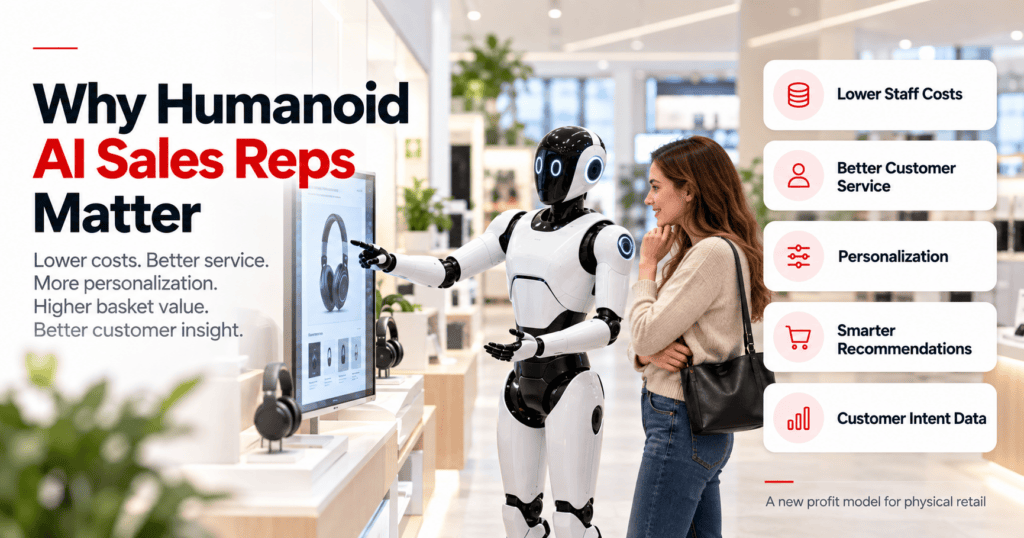
The first economic benefit is straightforward.
If repetitive frontline work can be automated, labour productivity increases.
The retailer can potentially:
reduce staffing requirements,
reduce recruitment costs,
reduce repeated training costs,
improve coverage during busy periods,
and reduce the economic impact of staff turnover.
But there is another benefit.
When product knowledge resides in the AI system, it no longer disappears whenever an employee resigns.
Knowledge becomes an enterprise asset, not an employee-dependent asset.
The second benefit is revenue.
Customers often leave stores because:
they cannot find someone,
the salesperson cannot answer,
they receive inconsistent advice,
or the decision becomes too difficult.
A Humanoid AI Sales Rep can be available continuously during store hours.
It doesn’t need to know everything itself.
It connects to the retailer’s knowledge and data.
The objective is simple:
answer more customers at the exact moment they are ready to make a decision.
Even a small increase in conversion across a large store network can create substantial value.
Physical retail has historically been surprisingly impersonal.
A salesperson may ask one or two questions and suggest a product.
AI can conduct a much more structured conversation.
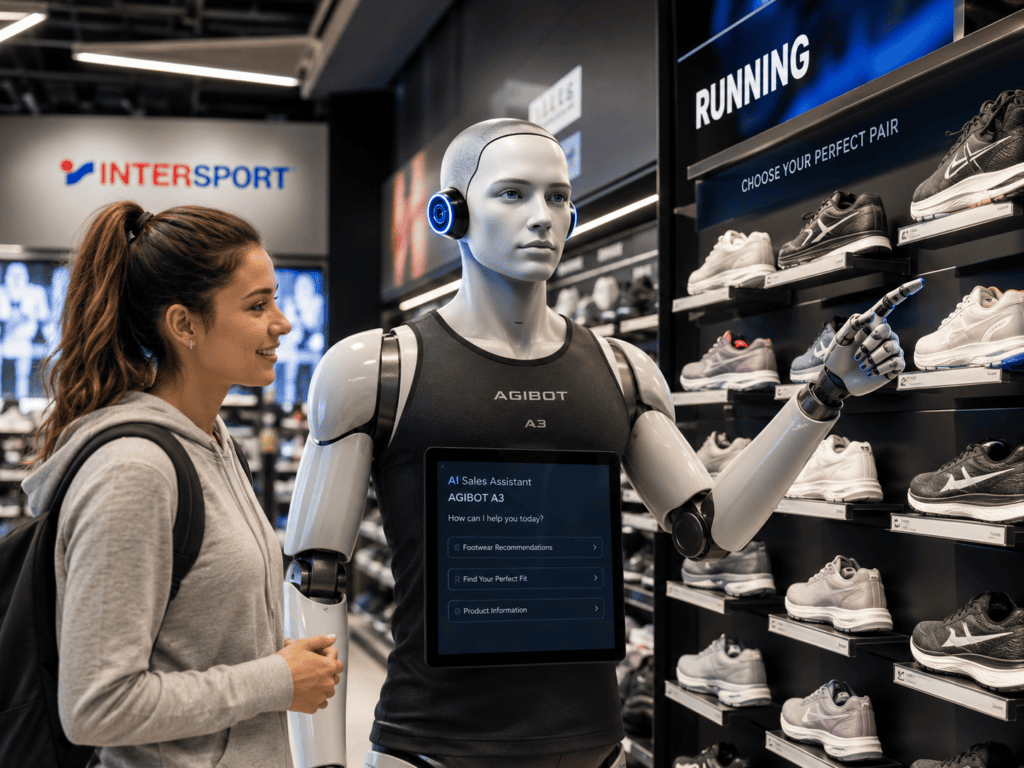
For example:
What are you trying to achieve?
What is your budget?
What matters most to you?
What products do you already own?
What size do you need?
What brands do you prefer?
What have you considered already?
The result is not simply product search.
It becomes personalized guided selling.
That is especially powerful in:
electronics,
appliances,
sports,
DIY,
furniture,
beauty,
and other high-consideration categories.
One of the largest opportunities is not simply helping the customer buy the original product.
It is helping them buy the complete solution.
Washing machine:
washing machine
Paint project:
paint
Laptop:
laptop
The recommendation engine can identify the relevant products automatically.
The result can be:
higher average basket value and higher gross profit per customer.
This may ultimately be even more important.
E-commerce knows enormous amounts about customer behaviour.
It knows:
what people searched,
what they viewed,
what they compared,
what they abandoned,
what they bought.
Physical stores generate enormous amounts of customer intent too.
But much of it disappears.
A customer tells a salesperson:
“I want this refrigerator but it is too expensive.”
That information usually disappears the moment the conversation ends.
A Humanoid AI Sales Rep can potentially capture:
what the customer wanted,
budget,
desired features,
brands considered,
objections,
products compared,
stock problems,
questions asked,
reasons for not buying.
With proper customer permission and data governance, that interaction can continue after the store visit.
For example:
the customer scans a QR code,
receives their recommended products,
gets notified if the price falls,
continues the basket online,
or receives personalized alternatives.
The store becomes part of a true omnichannel customer journey.
The conversation no longer ends when the customer walks out of the door.
The business case is not one benefit.
It is the combination of several.
Higher profit can come from:
Lower labour cost
Higher conversion
Higher average basket value
More personalized selling
More omnichannel follow-up
Better customer-intent data
That is the real opportunity.
Not “replace a person with a robot.”
Not “put something futuristic in the store.”
But redesign the economics of physical selling.
Until recently, I also looked at humanoid robots partly as fascinating technology.
Interesting.
Impressive.
Perhaps still a little gimmicky.
That changed when I saw modern humanoids up close.
You begin to understand the amount of engineering inside the machine.
The actuators.
The sensors.
The cameras.
The electronics.
The computing.
The balance.
The materials.
The mechanical design.
The perception systems.
The software.
A useful analogy is:
think of the engineering complexity of a modern BYD-class electric vehicle compressed into a body with legs, arms, cameras, sensors and AI.
Except the machine must continuously understand a three-dimensional environment and act safely inside it.
This does not mean humanoids are ready to do everything.
They aren’t.
But it means they should no longer be dismissed as toys.
The technology is moving from demonstration into real commercial applications.
The right first step is not:
“Let’s deploy 500 humanoids.”
The right first step is:
one store
one department
one robot
one clear customer problem
For example:
White Goods.
20–40 washing machines.
Three customer journeys:
product recommendation,
stock/price information,
basic product guidance.
Connect the robot to existing APIs.
Measure:
customer engagement,
recommendation accuracy,
conversion,
basket value,
staff handovers,
questions captured,
customer satisfaction,
and operational cost.
If the economics work:
expand to refrigerators.
Then TVs.
Then computers.
Then another store.
The investment should follow evidence.
The real question for retailers
The question is not:
“Will robots replace all salespeople?”
They won’t.
The better question is:
A future store may have fewer salespeople.
But the remaining people could be better paid, more motivated, more specialized and far more productive.
Alongside them could be permanent AI Sales Reps that know every product, every specification, every promotion and every recommendation rule.
Together they can provide something physical retail has struggled to deliver consistently:
expert advice for every customer, whenever they need it.
And that ultimately brings us back to the most important metric.
Not robotics.
Not AI.
Not innovation.
If Humanoid AI Sales Reps can reduce operating cost, increase conversion, improve customer service, personalize the shopping experience, increase basket value and transform physical-store conversations into usable omnichannel customer data, then they are not a technology experiment.
They are a new retail operating model.

Test out the Recommendation Engine for up to 20.000 euros in revenue from recommendations. No credit card required. Just enter your company information and we’ll contact you with all the details.
