Empower Your Business With The Magic Of Machine Learning!
- +30 210 9701777
- Aristotelous 83, Athens 163 43
- contact@mobiplus.co

Empower Your Business With The Magic Of Machine Learning!
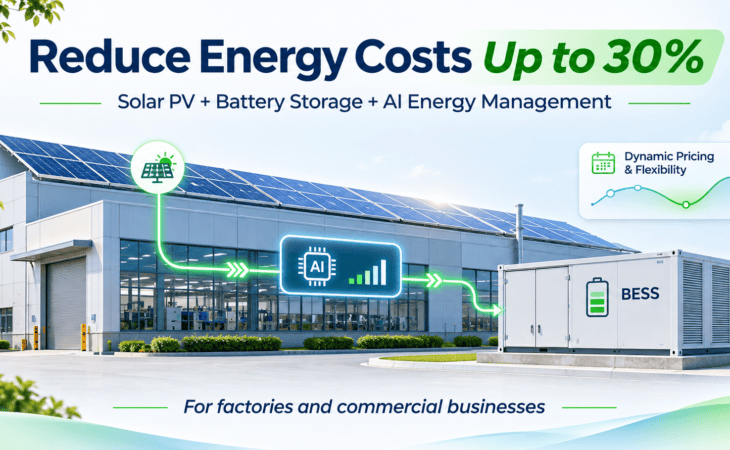
For many factories and commercial businesses, energy costs have become one of the most difficult operating expenses to control.
The challenge is no longer simply that electricity is expensive.
Industrial companies today face several problems at the same time:
A factory may therefore already have invested in solar PV and still be buying significant amounts of expensive electricity from the grid.
For many industrial and commercial sites, the missing element is battery energy storage combined with intelligent energy management.
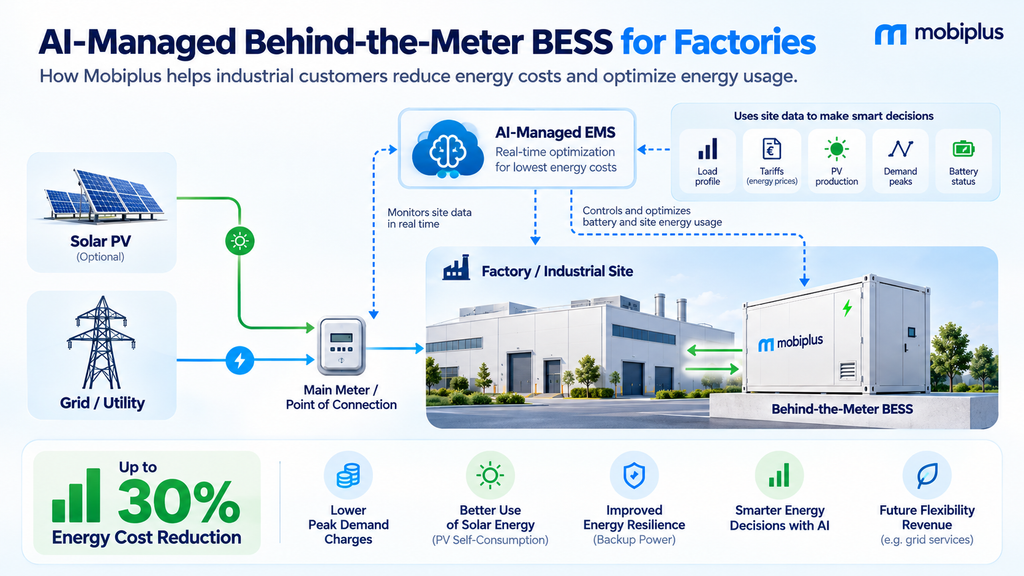
The opportunity is to combine:
to reduce industrial electricity costs—and potentially create additional revenue from energy flexibility.
A photovoltaic system solves only part of the energy-cost problem.
During sunny hours, the factory uses solar electricity directly and reduces electricity purchased from the grid.
But there are also periods when:
That excess solar energy may be exported to the grid at relatively low value, curtailed, or simply not utilized as effectively as it could be.
Then, only a few hours later, solar generation falls and the factory may need to buy electricity again from the grid—sometimes during much more expensive hours.
In other words:
A factory can produce inexpensive solar energy at 13:00 and then buy expensive electricity again at 20:00.
An industrial battery storage system changes this equation.
Instead of using solar electricity only at the moment it is produced, some of that energy can be stored and used later.
But simply installing a battery is not enough.
The real value comes when the battery is controlled by an intelligent Energy Management System—EMS.
The EMS continuously decides:
The Battery Energy Storage System—BESS—therefore becomes an active energy-management asset rather than simply a large battery.
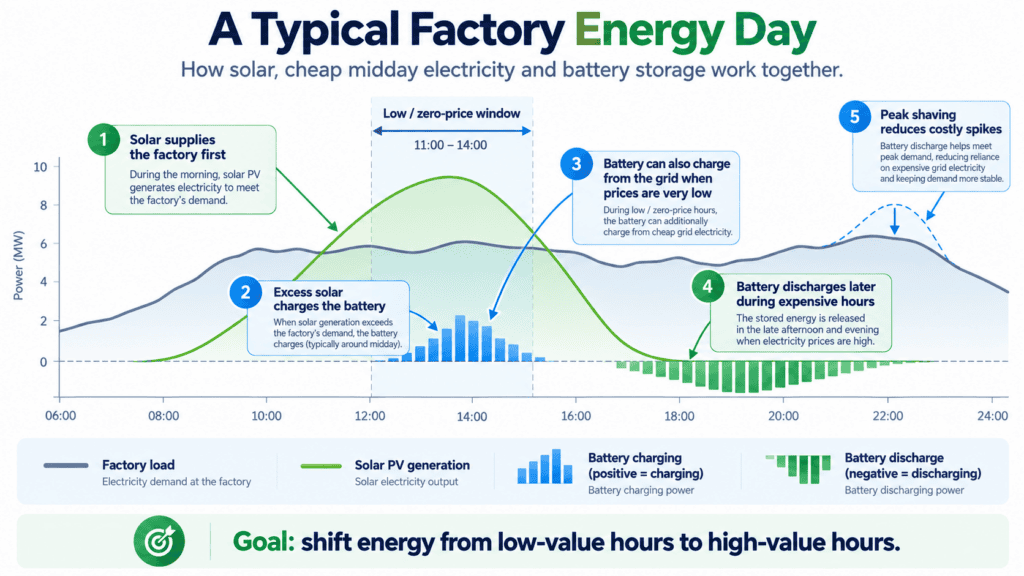
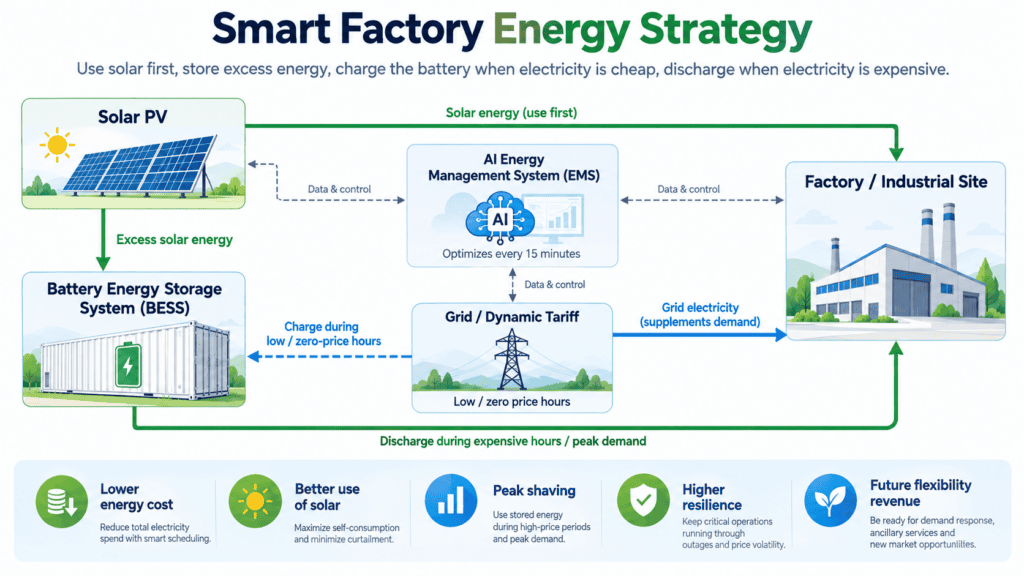
The operating strategy can be understood through five basic steps.
The first priority is normally:
When the photovoltaic system is generating electricity while production is operating, solar energy replaces electricity that would otherwise have been purchased from the grid.
This is the simplest form of solar self-consumption and normally creates immediate savings.
For energy-intensive businesses, every kWh produced and consumed internally reduces exposure to purchased electricity.
If the PV system produces more electricity than the factory needs at that moment:
Instead of exporting that energy at relatively low value, the factory can store it.
Later in the afternoon or evening, when solar production falls and electricity prices increase:
This increases solar self-consumption and improves the economic value of an existing photovoltaic installation.
This is where dynamic electricity pricing can make industrial battery storage particularly interesting.
Electricity prices increasingly vary by hour.
In Greece, high renewable generation—especially solar power—can create periods of very low wholesale electricity prices around midday.
Certain dynamic electricity products can even create periods when the energy-supply component of the electricity price falls to €0/kWh.
When this happens, the optimal strategy may be:
while:
continues supplying production.
This is an important point.
Many people initially assume that all excess PV should always be placed in the battery.
That is not necessarily the most profitable strategy.
If grid electricity is extremely cheap, it can sometimes be more economical to use the solar production directly in the factory while using cheap grid electricity to charge the battery.
The AI Energy Management System makes this decision automatically according to:
Later in the day:
Stored electricity replaces electricity that would otherwise have been purchased from the grid at a much higher price.
The BESS therefore performs electricity price arbitrage:
For an energy-intensive business operating many hours per day, this difference can become financially significant.
Industrial electricity costs are not determined only by total kWh consumption.
Large demand peaks can also create costs.
For example, several large:
may operate simultaneously and cause factory demand to rise sharply.
Instead of taking the entire demand peak from the electricity grid:
The battery temporarily supplies part of the load.
This is known as:
Peak shaving can potentially:
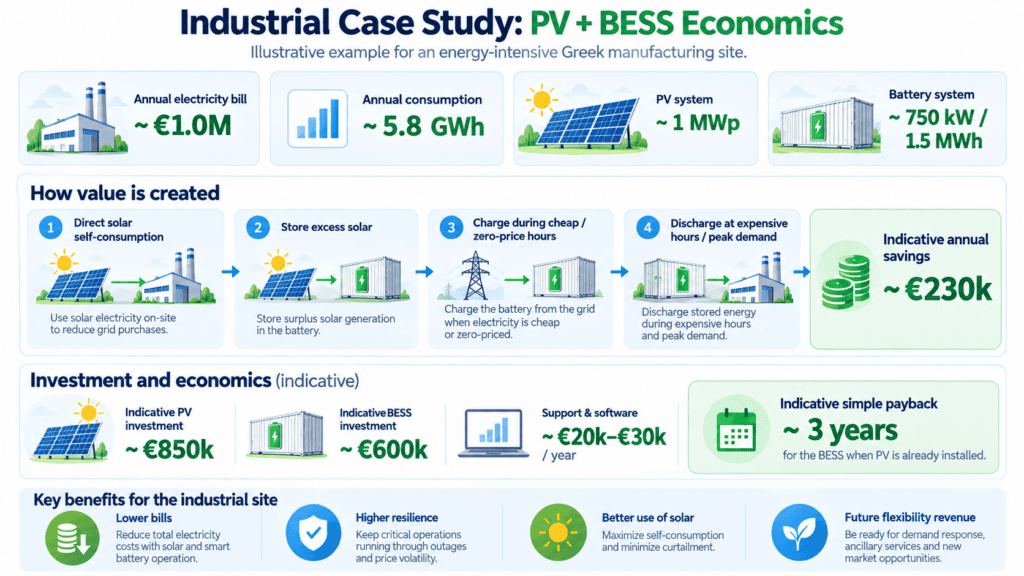
Consider a Greek industrial plant operating in the industrial minerals and manufacturing sector.
The company uses energy-intensive production equipment and operates approximately:
Its real electricity-consumption profile was analysed using twelve months of certified 15-minute meter data.
Annual electricity consumption is approximately:
Average electrical load is approximately:
while measured 15-minute demand peaks reach approximately:
Annual electricity expenditure is around:
This is exactly the type of industrial electricity profile where solar and battery storage can become particularly interesting.
For this case study, the factory is assumed to already have approximately:
and we then analyse the addition of approximately:
controlled by an intelligent EMS.
Imagine a normal sunny production day.
The factory is operating.
Grid electricity and solar PV supply production.
As solar generation increases, electricity purchased from the grid decreases.
Solar production becomes strong.
The factory uses PV electricity directly.
If solar generation exceeds immediate factory demand:
The Energy Management System is simultaneously monitoring hourly electricity prices.
Suppose that a dynamic electricity tariff provides a very-low-price or zero-energy-price window approximately between:
If battery capacity is still available, the EMS can also use:
The BESS can therefore have two potential charging sources:
and
Solar generation starts falling.
Electricity prices may increase.
Instead of purchasing all required electricity from the grid:
The EMS chooses the hours where every stored kWh generates the highest financial value.
At the same time, the battery can also react to production peaks.
Using the factory’s actual 15-minute electricity-consumption profile together with real hourly dynamic electricity prices, we modelled how PV and battery storage could work together.
The indicative configuration was:
plus
The model combines:
The resulting potential annual economic value is approximately:
under a favourable integrated operating scenario.
For a factory with an electricity bill around €1 million, this illustrates why industrial energy-cost reductions approaching 20–30% can become possible in suitable sites.
However, “up to 30%” should not be interpreted as a guaranteed saving for every factory.
Actual savings depend on factors including:
A proper feasibility study must therefore use the customer’s real electricity data.
For this type of installation, a preliminary planning budget for a:
could be approximately:
depending on equipment, site conditions and final project scope.
A complete industrial battery-storage project may include:
If the factory has already installed its photovoltaic system, the previous PV investment is a sunk investment and should normally not be included again when calculating the incremental economics of adding a BESS.
Annual software, monitoring, maintenance and technical support could typically require approximately:
depending on the architecture and service agreement.
Potentially—but this calculation must be made carefully.
If a business already has solar PV and the additional BESS investment is approximately:
then incremental annual value of approximately:
would mathematically produce a simple payback of approximately:
However, this is where industrial BESS studies need to distinguish carefully between:
and
Not all savings from an integrated PV + BESS system should automatically be attributed to the battery.
Therefore:
A three-year battery-storage payback should be treated as an attractive high-performance scenario—not as a guarantee.
For other industrial sites the result could be four, five, six years or more.
The investment decision should only be taken after modelling the actual factory load, PV generation and electricity tariff.
Looking only at electricity-price arbitrage can underestimate the total business value of an industrial battery.
An industrial power interruption can cost considerably more than the electricity itself.
Depending on the production process, an outage may cause:
A properly engineered BESS can support selected critical loads during short disturbances or outages.
The financial value varies enormously by factory, so resilience should normally be quantified separately.
A factory increasing production may eventually exceed its current electrical connection capacity.
Increasing:
can be expensive and time-consuming.
Battery storage can sometimes provide power during temporary production peaks and help postpone an infrastructure upgrade.
For expanding industrial businesses, this can create additional value that is not immediately visible in the electricity bill.
For businesses that already have photovoltaics, battery storage increases the strategic value of the existing solar investment.
Without storage:
With storage:
This can increase self-consumption and reduce dependence on grid electricity.
A professional battery-storage study should not start with the question:
“How large a battery would you like?”
It should start with the factory’s real electricity data.
At minimum, the analysis should include:
The model can then simulate several BESS sizes, for example:
The objective should not be to sell the biggest battery possible.
The objective is:
to identify the smallest BESS that captures most of the available economic value.
Traditionally, the relationship between a factory and electricity was straightforward:
The factory consumed electricity and paid for it.
With:
the business can increasingly control:
when to generate electricity,
when to consume it,
when to store it,
and
when to purchase it from the grid.
This alone represents a significant transformation in industrial energy management.
But there is another opportunity that many companies in Greece still know very little about.
Battery storage does not have to create value only by reducing electricity costs.
There may be periods when part of the battery’s power or stored energy is not required by the factory.
This unused capacity can potentially become:
and energy flexibility can have a financial value.
Through an aggregator such as Sympower, eligible industrial loads and battery systems can potentially participate in the Greek balancing and flexibility markets.
If the electricity system needs additional power, a battery might temporarily:
If the grid has excessive renewable production, the battery could potentially:
The factory can therefore potentially receive additional revenue for helping the electricity system balance production and consumption.
Many industrial facilities operate large electrical loads such as:
Some of these loads may be capable of temporarily reducing or changing consumption for a few minutes without significantly affecting production.
For example:
A factory consuming:
might temporarily reduce electricity demand by:
That reduction in demand can itself become an energy-market service.
An aggregator can combine the flexibility of many factories and batteries into a larger portfolio and offer that flexibility to the electricity system.
The factory therefore has the potential to receive compensation for participating in demand response and balancing services.
The complete industrial energy strategy therefore has five potential value streams:
Use solar electricity directly instead of buying electricity from the grid.
Charge the BESS when electricity is inexpensive and discharge when electricity is expensive.
Reduce expensive power-demand peaks.
Protect critical production processes against short grid disturbances and outages.
Monetize available battery capacity or flexible industrial loads through demand-response and balancing markets.
The first four primarily:
The fifth can potentially:
Flexibility revenue should not automatically be included in the basic battery ROI until it has been specifically evaluated for the site.
However, where the technical and market conditions are suitable, it can further improve the economics of an industrial energy-storage project.
The real opportunity is therefore much bigger than simply buying a battery.
The complete architecture becomes:
working together as one intelligent system.
The Energy Management System continuously decides:
For energy-intensive factories and businesses, electricity is gradually changing from a largely uncontrollable operating expense into a resource that can increasingly be:
generated,
stored,
optimized,
shifted,
and potentially:
The objective is therefore no longer simply to reduce the electricity bill.

Test out the Recommendation Engine for up to 20.000 euros in revenue from recommendations. No credit card required. Just enter your company information and we’ll contact you with all the details.
