Empower Your Business With The Magic Of Machine Learning!
- +30 210 9701777
- Aristotelous 83, Athens 163 43
- contact@mobiplus.co

Empower Your Business With The Magic Of Machine Learning!
For the last few years, we have been talking about how Generative AI will transform customer service, retail, hospitality and other customer-facing industries.
We can stop talking about it in the future tense.
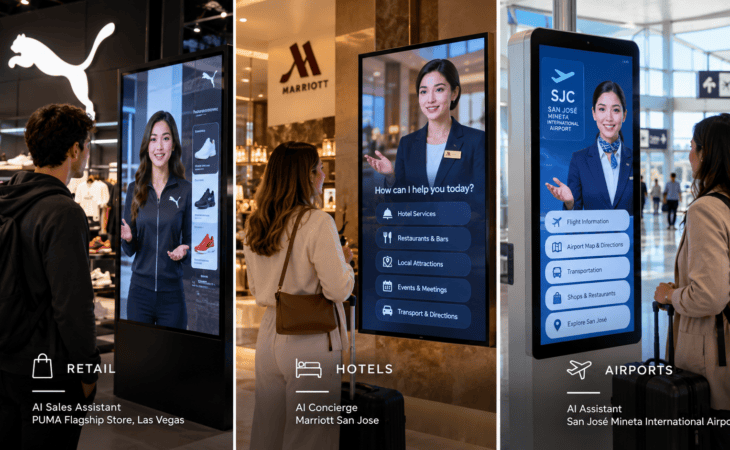
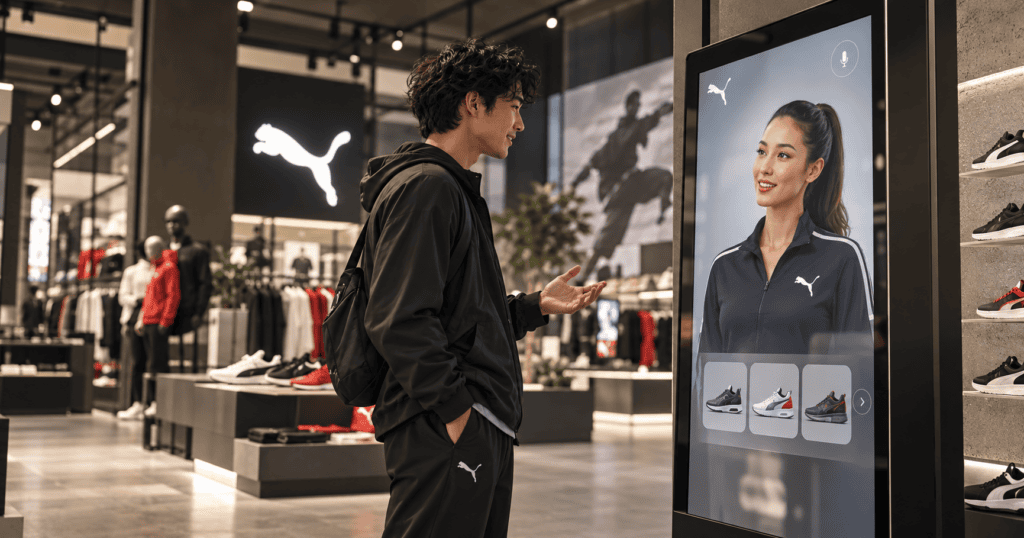
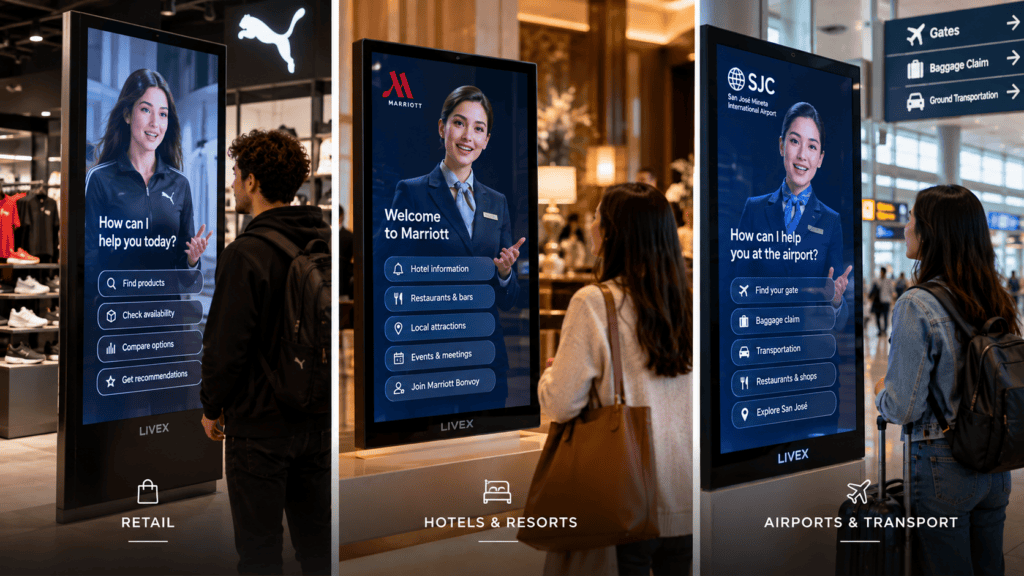
At a PUMA flagship store in Las Vegas, customers can walk up to a seven-foot AI Sales Assistant, talk to it naturally, ask questions about products, receive recommendations and check real-time inventory.
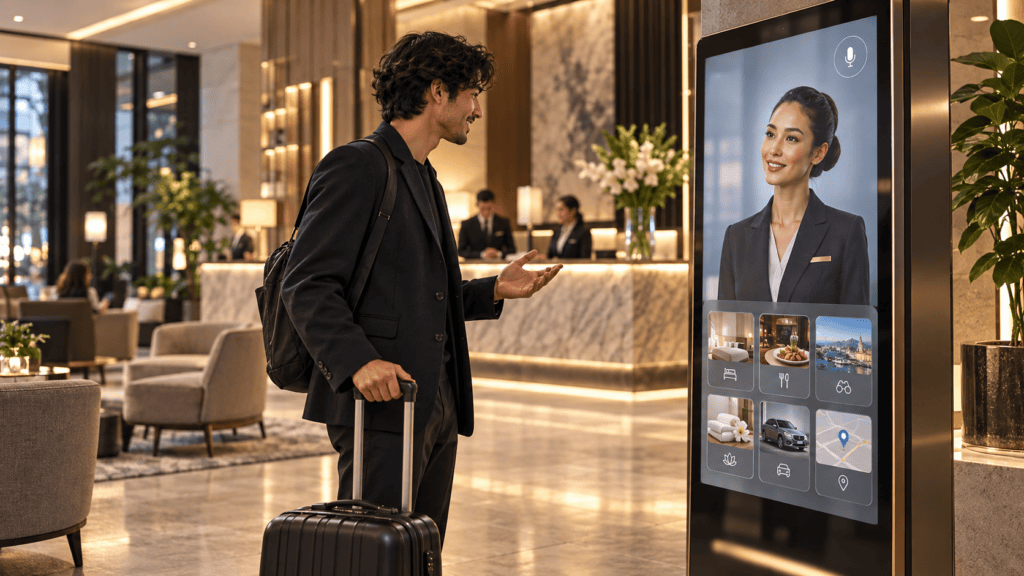
At the San Jose Marriott, hotel guests can talk to an AI concierge in their own language, ask about hotel services and the surrounding area, while the same system is also being used to acquire loyalty members and create new commercial opportunities.
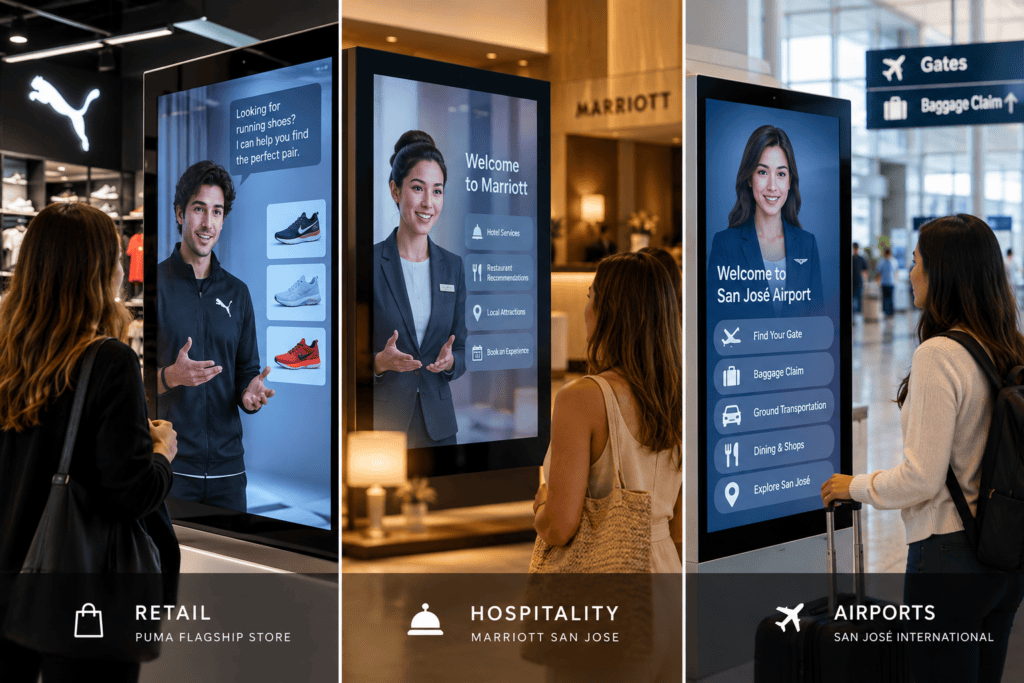
At San José Mineta International Airport, AI holograms and kiosks have already been installed in passenger areas to help travellers navigate the airport and find information.
MediaMarktSaturn is already providing AI-guided product advice across European markets, including Spain, helping customers choose complex products.
And at the headquarters of Sojitz Tech-Innovation in Tokyo, visiting executives are welcomed by a life-size conversational AI avatar.
These are not laboratory prototypes.
They are not PowerPoint presentations.
They are not predictions.
They are operating systems interacting with real customers in real physical locations today.
The next stage of AI is therefore not simply better chatbots.
It is the emergence of the AI Sales Representative and the AI Physical Assistant.
And I believe this represents a major opportunity for retailers, hotels, airports, tourism organisations, pharmacies, utilities, government organisations and large enterprises in Greece.
From information kiosk to AI Sales Representative
Retail may be one of the industries where Physical AI creates the clearest business case.
Think about what happens every day in an electronics store, DIY store, furniture retailer, sporting-goods store, cosmetics shop or telecom store.
A customer walks in.
They want to buy something, but they don’t necessarily know exactly what.
They may have 10, 50 or even hundreds of products to choose from.
They need advice.
A customer in an electronics retailer might say:
“I need a 65-inch television. My living room is very bright, I mainly watch football and Netflix, and I don’t want to spend more than €1,200.”
Today, the experience depends largely on whether an appropriate salesperson is available and how knowledgeable that salesperson happens to be about that category.
An AI Sales Representative changes this.
The customer simply talks.
The AI can ask follow-up questions.
What size is your room?
What is your budget?
Is picture quality or sound more important?
Do you play games?
Do you have a particular brand preference?
The system can then analyse the retailer’s own product range and recommend suitable products.
But this becomes really powerful when the AI is connected to the retailer’s actual systems.
It can access the product catalogue.
Specifications.
Prices.
Promotions.
Inventory.
Available colours.
Store availability.
Delivery information.
And potentially CRM and loyalty information when the customer chooses to identify themselves.
This is already happening.
PUMA: a real AI assistant working on the shop floor
At PUMA’s Las Vegas flagship store, LiveX AI has deployed “Dylan,” a seven-foot AI-powered retail assistant.
Dylan can talk naturally with shoppers, answer product questions, make recommendations, recognise products, communicate in more than 100 languages and—critically—check live inventory through backend system integrations.
That last point is fundamental.
The value is not the avatar itself.
The value comes when the avatar becomes an intelligent interface to the retailer’s actual business.
This is no longer simply “AI that talks.”
It is AI that knows what the retailer sells and what is actually available.
MediaMarktSaturn: product advice is already scaling across Europe
MediaMarktSaturn provides another important example.
Through Aiden, MediaMarkt provides guided digital advice for complex product categories.
The system asks customers questions and helps narrow large product selections to products that match their needs.
MediaMarkt began its Aiden rollout in late 2024. Within six weeks, 48 guided-selling experiences were running across four countries. The system subsequently expanded into additional markets including Spain, Italy, Poland, Turkey and Switzerland. Aiden reports that shoppers who use this type of guided advice convert significantly better than ordinary visitors.
This provides an important lesson for physical retail.
Customers do not necessarily want to scroll through 80 televisions or 60 laptops.
They want someone—or something—to understand what they need and say:
“Based on what you have told me, these are the three products I would recommend, and this is why.”
Physical AI brings that same intelligence directly onto the shop floor.
For Greek retailers such as electronics chains, DIY retailers, furniture companies, cosmetics retailers, sporting-goods chains and telecom stores, this is no longer a hypothetical use case.
The technology exists.
A concierge that speaks every guest’s language — and can also generate revenue
Hotels face a different problem, but the underlying principle is the same.
Every day, reception staff answer enormous numbers of repetitive questions.
“What time is breakfast?”
“Where is the spa?”
“How do I book the restaurant?”
“Where can I get a taxi?”
“How do I reach the airport?”
“Can you recommend a good Greek restaurant nearby?”
“What should we visit tomorrow?”
“What time does the Acropolis close?”
“Where is the conference room?”
These questions are important.
But does every one of them require a receptionist?
Marriott San Jose: AI concierge became a business channel
The San Jose Marriott provides one of the clearest examples of how quickly the role of Physical AI can expand.
LiveX originally installed its conversational AI concierge to support guests around NVIDIA GTC.
The installation remained.
Guests could interact with the system in their own language instead of waiting at reception and receive information about the hotel and local area.
But the interesting part is what happened next.
The same physical installation evolved into three different business functions.
It remained a hotel concierge.
It became a sponsored engagement platform used with brands including Google Cloud and NVIDIA.
And it became a Marriott Bonvoy customer-acquisition channel.
LiveX reports that roughly one in ten guests participating in the Bonvoy selfie experience registered for Marriott Bonvoy.
That changes the economics completely.
The AI concierge is no longer only a way of reducing repetitive questions at reception.
It can contribute to:
customer service,
loyalty acquisition,
upselling,
guest engagement,
sponsorship,
and ultimately revenue.
The same model has already expanded into other hotels.
At Hilton Santa Clara, LiveX reports that within the first three months its AI concierge achieved a guest rating of 4.76/5 and converted 11.3% of participating selfie guests into Hilton Honors members. The hotel also used the installation for paid branded corporate-event experiences.
For Greece—with thousands of hotels, resorts and millions of international visitors—the opportunity is obvious.
Imagine entering a resort in Crete, Rhodes, Mykonos, Corfu or Halkidiki.
The guest asks in German:
“What activities do you have for children tomorrow?”
Another guest asks in French:
“Which restaurant do you recommend for seafood nearby?”
Another asks in Italian:
“How do I get to the old town?”
Another asks:
“Can I book the spa for 5pm?”
One AI concierge can communicate naturally with all of them.
And the hotel’s people can spend more time doing what hospitality employees do best:
creating relationships with guests.

Physical AI is already inside an airport
Airports are ideal environments for Physical AI because they combine high passenger volumes, repeated questions, multiple languages and enormous quantities of constantly changing information.
Travellers want to know:
Where is my gate?
Where is baggage claim?
Where can I get a taxi?
Where is the metro?
How long will it take me to reach my gate?
Where is the lounge?
Where can I eat?
Where is passport control?
How can I get into the city?
And international passengers may ask those questions in dozens of languages.
Again, this is not just a theoretical use case.
San José Mineta International Airport
During Super Bowl week, San José Mineta International Airport installed LiveX AI’s Halo hologram and Gateway kiosk units at locations across the airport.
Units were placed both in publicly accessible baggage-claim areas and behind security near the gates.
Passengers could ask questions about the airport and San José, receive navigation help and interact with additional experiences provided through the system. The airport itself publicly confirmed the deployment and encouraged travellers to use the LiveX holograms for airport and city information.
Think about the application at Athens International Airport, regional Greek airports, ports, ferry terminals and major transportation hubs.
An international traveller arriving in Greece could ask:
“How do I get to Syntagma?”
“Where is the Metro?”
“Where can I rent a car?”
“Where is Gate B22?”
“Can you recommend somewhere to eat before my flight?”
“Where do I get my VAT refund?”
The same AI can answer those questions in the traveller’s language.
And this creates another important opportunity.
The airport assistant does not have to stop at airport information.
It can also become the traveller’s first digital introduction to Greece.
A destination can have its own AI representative
The same concept can move outside the airport.
Imagine an AI assistant at a major archaeological site, marina, museum, convention centre or tourist information point.
A visitor asks:
“What should I see here?”
“Tell me the history of this building.”
“What attractions are within walking distance?”
“Where should I eat?”
“What activities would you recommend for my children?”
“How do I get to Cape Sounion?”
“Are there tickets available for tonight’s performance?”
Physical AI can combine information from the attraction itself with destination information, maps, transport, local businesses, events and tourism services.
And because the conversation is interactive, recommendations can become personalised.
A 25-year-old traveller looking for nightlife should not receive the same recommendations as a family with three young children.
A cruise passenger with four hours available should not receive the same itinerary as someone staying in Athens for five days.
This creates an entirely new type of tourist-information service:
a destination expert that the visitor can simply talk to.
For a tourism economy such as Greece, the possibilities are substantial.
Product guidance without turning AI into a doctor
Pharmacies and health-and-beauty stores represent another interesting application, provided the boundaries are clearly defined.
The purpose is not for an AI avatar to diagnose illness or replace a pharmacist.
The opportunity lies primarily in non-medical product information and product discovery.
Imagine a customer asking:
“I am looking for a moisturising cream for very dry skin.”
“What is the difference between these two sunscreens?”
“Which vitamin products in this range are sugar-free?”
“Where are the hair-loss shampoos?”
“What face cream products are available from this brand?”
The AI can access approved product information and help the customer navigate a very large assortment.
For pharmacy chains, beauty retailers and cosmetics stores, this potentially improves product discovery while freeing trained staff to concentrate on customers who actually need professional human advice.
And importantly, clear business rules can define exactly what the AI is and is not allowed to discuss.
Imagine citizens asking questions instead of searching for the right counter
Anyone who has visited a large public-sector building knows the problem.
People arrive and ask:
“Where do I go?”
“Which department handles this?”
“Which documents do I need?”
“Do I need an appointment?”
“Where is office 312?”
“What is the procedure?”
Often the information already exists.
The problem is accessing it easily.
An AI Physical Assistant at the entrance of a ministry, municipality, public organisation or large government facility could provide immediate conversational guidance.
Instead of forcing the citizen to understand the structure of the organisation, the citizen simply describes what they need.
“I want to submit this application.”
“I need to change this information.”
“I received this letter. Where should I go?”
The AI can guide them to the correct department, explain the approved procedure and identify required documents.
The concept has already moved into corporate reception.
Sojitz Tech-Innovation: AI as the first point of contact
At Sojitz Tech-Innovation’s Executive Briefing Center in Tokyo, LiveX deployed a life-size Japanese-speaking AI avatar at the entrance.
It welcomes senior business visitors and provides a natural conversational interface in an executive environment.
The principle can easily extend beyond corporate reception.
Large government organisations, municipalities, banks, utility companies and corporate headquarters all have environments where people repeatedly need directions, procedures and basic information.
From queue management to conversational service
Consider an organisation such as PPC in Greece.
Customers may enter a location wanting information about:
products,
tariffs,
new services,
documents,
payments,
applications,
procedures,
energy programmes,
or which employee or department they actually need.
Much of this information already exists digitally.
Physical AI can make it accessible conversationally at the exact point where the customer needs it.
The assistant can answer standard questions immediately and identify when the customer actually needs a human employee.
Instead of every customer joining the same queue, the AI can help triage demand.
Some interactions may be completed entirely through AI.
Others can be routed intelligently to the correct employee.
The objective is not eliminating human service.
It is ensuring that human service is used where humans create the most value.
Whenever AI enters a physical environment, the first question is often:
“Will this replace employees?”
I think that is the wrong starting point.
The better question is:
What should our people actually be spending their time doing?
Do we want an experienced hotel receptionist repeatedly explaining where breakfast is located?
Do we want an excellent electronics salesperson spending ten minutes telling someone where to find HDMI cables?
Do we want a pharmacist pointing customers towards cosmetic shelves when another customer needs professional advice?
Do we want a public employee explaining directions to a department fifty times every morning?
There are tasks technology can perform extremely well.
And there are tasks humans perform much better.
People create trust.
People understand unusual circumstances.
People show empathy.
People negotiate.
People persuade.
People solve complicated problems.
People create relationships.
Physical AI should free people to spend more time doing those things.
It is easy to look at one of these installations and think:
“The innovation is a nice avatar on a large screen.”
It isn’t.
The screen is only the visible part.
Behind it sits the real system.
The conversational engine understands the customer.
The AI interprets intent.
The knowledge system provides approved information.
Business rules determine what the AI can and cannot do.
Then integrations connect the AI to the organisation’s existing technology.
For a retailer that could mean:
ERP → product catalogue → prices → promotions → inventory → e-commerce → recommendations → CRM → loyalty.
For a hotel:
property information → amenities → restaurants → events → local information → loyalty → CRM.
For an airport:
flight and facility information → maps → gates → transportation → city information.
For government:
departments → procedures → documents → locations → appointments.
This integration layer is what converts an impressive avatar into a useful enterprise application.
Physical businesses historically know far less about their visitors than digital businesses.
An e-commerce business can understand what somebody searched.
What they clicked.
What they compared.
What they added to the basket.
What they abandoned.
A physical store often knows almost nothing about the customer who walked around for 25 minutes and then left.
Conversational AI can begin closing that gap.
The conversation itself creates useful customer intent.
“I am renovating my kitchen.”
“I need a laptop for university.”
“I am travelling with two children.”
“I am looking for skincare for dry skin.”
With explicit customer consent, the AI can then ask:
“Would you like me to email you the products we discussed?”
Now the interaction does not disappear when the customer leaves.
The customer receives the recommendations.
The CRM can record the interest where appropriate.
Marketing automation can nurture the relationship.
A salesperson can potentially follow up.
This is where Physical AI becomes much more than customer service.
It becomes part of the sales and customer-acquisition infrastructure.
This is precisely where we see the role of MobiPlus.
Companies such as LiveX are creating the Physical AI platform:
the avatar,
the conversational technology,
the physical kiosk or holographic interface,
the AI infrastructure,
and the mechanism for engaging naturally with a customer.
But every enterprise has different systems.
Different ERP.
Different product catalogue.
Different CRM.
Different pricing.
Different inventory.
Different hotel information.
Different loyalty programme.
Different business rules.
Different customer journey.
This is the missing layer that MobiPlus provides.
MobiPlus can integrate the Physical AI platform with ERP, e-commerce platforms, product feeds, CRM, PIM, inventory, loyalty systems and other enterprise information sources.
In retail, we can also combine it with our existing shopping-personalisation and recommendation technology.
We define together with the customer what the AI should know.
What it should recommend.
What data it can access.
What questions it should answer.
When it should collect customer information.
When it should trigger an email.
When it should transfer the conversation to a human.
And how we measure whether it is actually generating business value.
Until recently, executives could reasonably ask:
“Will customers really talk to an AI avatar in a physical location?”
We now have the answer.
They already are.
They are doing it at PUMA.
They are doing it at Marriott.
They are doing it at Hilton.
They are doing it at San José International Airport.
They are receiving AI-guided product advice from MediaMarktSaturn across Europe.
Executives are being welcomed by AI avatars at Sojitz Tech-Innovation.
LiveX has also deployed multiple conversational AI agents across major NVIDIA events and large international sporting environments.
So the strategic question for Greek organisations is no longer:
“Is Physical AI coming?”
It is:
“Where in our organisation should we deploy it first?”
One store department?
One flagship location?
One hotel lobby?
One airport area?
One corporate headquarters?
One public-service centre?
That is how I believe organisations should approach this technology.
Not with a massive transformation project.
Start with one important customer journey.
Integrate the AI with the information and systems required for that journey.
Define measurable KPIs.
Measure customer engagement.
Measure questions answered.
Measure sales or leads.
Measure employee time released.
Measure customer satisfaction.
Learn.
And then scale.
Because Physical AI is not waiting for the future.
The AI Sales Representative is already working on the shop floor.
The AI Concierge is already standing in hotel lobbies.
The AI Assistant is already helping passengers inside airports.
The physical and digital worlds are finally beginning to connect.
And for organisations willing to move early, the opportunity is not simply to reduce costs.
It is to redesign the entire way they interact with customers.

Test out the Recommendation Engine for up to 20.000 euros in revenue from recommendations. No credit card required. Just enter your company information and we’ll contact you with all the details.
