Empower Your Business With The Magic Of Machine Learning!
- +30 210 9701777
- Aristotelous 83, Athens 163 43
- contact@mobiplus.co

Empower Your Business With The Magic Of Machine Learning!
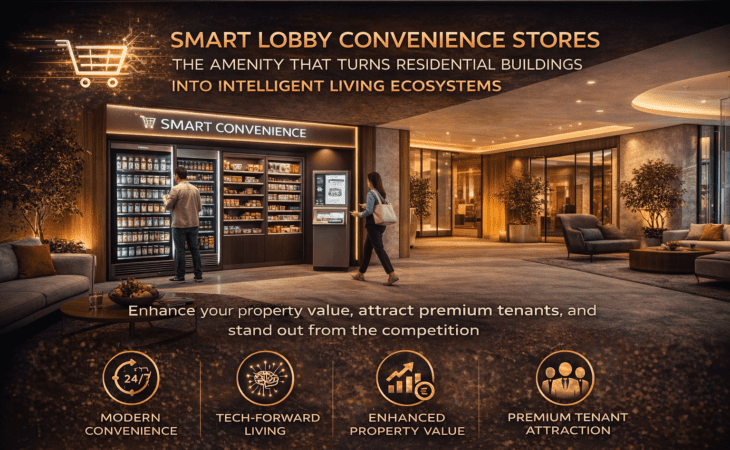
Real estate development has always been a game of differentiation.
Location, architecture, finishes, and pricing once defined competitive advantage. Later, amenities entered the equation — gyms, concierge services, co-working areas, smart parking, and wellness spaces.
Today, however, we are entering a new phase where differentiation is no longer defined by physical infrastructure alone, but by digital services, intelligent automation, and everyday convenience embedded directly into the living environment.
Residents are no longer evaluating buildings purely as places to live.
They evaluate them as service platforms — ecosystems that support their daily lifestyle.
They expect frictionless access to essentials, personalization, digital interaction, and time-saving experiences that mirror the convenience standards set by e-commerce and on-demand services.
This is where Smart Lobby Convenience Stores emerge as a transformative innovation.

These are not traditional vending machines, nor small retail corners. They are AI-enabled, data-driven, automated retail environments integrated into the building’s common spaces — providing residents access to daily essentials 24/7, with intelligent personalization, contactless transactions, and zero operational burden for the developer.
Most importantly — and this represents a strategic shift — their value is not measured primarily by direct financial participation.
Their true impact lies in enhancing the attractiveness, market positioning, and long-term value of the real estate asset itself.
This article explores in depth how Smart Lobby Convenience Stores create measurable and intangible value for developers and investors, strengthening existing investments while differentiating properties in increasingly competitive markets.
The Rise of the Convenience Economy
Modern urban residents operate within a convenience-driven mindset shaped by:
Convenience has evolved from luxury to expectation. When evaluating living environments, residents subconsciously assess:
Developments failing to meet these expectations risk appearing outdated — even if architecturally impressive.
Smart Lobby Stores address this shift directly by embedding convenience into the living space itself.
Time as the Most Valuable Commodity
For residents, small time savings compound significantly:
A building that removes friction from daily routines becomes more than housing — it becomes a productivity and lifestyle enhancer.
This perceived time value translates directly into:
These factors ultimately protect and increase the asset’s market strength.
What They Are
Smart Lobby Stores are compact automated retail installations placed within residential buildings, offering:
Powered by:
They operate continuously without staff, eliminating operational complexity.
What They Are Not
They are not:
They are service infrastructure — closer to elevators or smart access control systems than to retail tenants.
This distinction is critical when evaluating their value proposition.
Read our book and learn why instore personalization and shopping data is the name of the game.

Enhancing Property Market Positioning
In saturated markets, differentiation drives faster absorption and premium pricing.
Smart Lobby Stores provide:
Developers can position properties as:
This positioning affects both:
Even subtle differentiation can influence purchase decisions.
Increasing Asset Desirability
Prospective residents compare properties across similar price brackets. When one offers:
It stands apart psychologically — even before quantitative evaluation begins.
This increased desirability contributes to:
Supporting Premium Pricing Strategy
While Smart Lobby Stores do not directly generate developer revenue initially, they support:
Buyers and tenants often assign monetary value to convenience and services indirectly.
Amenities influence willingness to pay.
Even marginal price uplifts across units significantly outweigh installation cost impacts.
Elevating Everyday Living
Residents experience:
This creates emotional value associated with the building itself.
Emotional attachment strengthens:
Personalization and AI Interaction
Modern systems can deliver:
Residents perceive the environment as responsive — a hallmark of next-generation living spaces.
This contributes to the identity of:
“Intelligent Residential Infrastructure”
Social and Community Impact
Shared smart amenities become interaction points that:
Buildings evolve from static structures into dynamic ecosystems.
Zero Management Burden
Developers face:
Deployment and operation are externally managed.
Space Optimization
Small footprint utilization:
Efficient space activation improves asset utility metrics.
Future Scalability
Systems can evolve to include:
Developers gain infrastructure that grows in capability.
Signaling Innovation Leadership
Developers adopting intelligent retail amenities demonstrate:
This builds brand equity beyond individual projects.
Media and Marketing Leverage
Innovative amenities enable:
They provide tangible innovation examples rather than abstract claims.
Investor Confidence
Innovation-driven properties signal:
These characteristics influence investor perception and portfolio attractiveness.
Amenities Arms Race
Traditional amenities are commoditized:
They no longer differentiate meaningfully.
Smart services represent the next competitive frontier.
Early Adoption Advantage
Early adopters benefit from:
Late adopters appear reactive rather than visionary.
Alignment with Smart City Evolution
Urban environments are integrating:
Buildings lacking intelligent layers risk obsolescence perception.
Preparing for Autonomous Commerce
Retail is shifting toward:
Smart Lobby Stores position assets within this transition.
While indirect, measurable indicators include:
These influence asset performance and long-term value.
Developers historically evaluated amenities based on:
Direct revenue generation
The modern paradigm evaluates them based on:
Ecosystem value creation
Smart Lobby Stores belong firmly in the second category.
They strengthen the investment rather than monetize space.
Real estate innovation rarely arrives through dramatic structural reinvention.
Instead, it emerges through subtle integrations that reshape everyday experience — quietly transforming expectations and redefining competitive baselines.
Smart Lobby Convenience Stores represent such an integration.
They:
Their value lies not in rent participation or revenue sharing, but in the compound effect they have on how buildings are perceived, marketed, lived in, and remembered.
Developers who understand this shift recognize a broader truth:
The future of residential real estate is not defined solely by square meters and materials — it is defined by intelligent services woven into the living fabric.
And the buildings that embrace this transformation today will set the expectations that others must follow tomorrow.

Test out the Recommendation Engine for up to 20.000 euros in revenue from recommendations. No credit card required. Just enter your company information and we’ll contact you with all the details.
